The Golden Circle – Simon Sinek’s leadership concept
With the Golden Circle concept, you make your company stand out from the crowd and ask the right questions about strategy, leadership and vision.
What you should know as a business owner: The Golden Circle
Being different, making your own company stand out from the crowd. Selling not only the product, but also a story, a certain style, an attitude to life. That is what many people want to achieve today, and have to, in order to survive in the fiercely competitive market. Steve Jobs managed this with Apple. And he did so long before Simon Sinek wrote “The Golden Circle”.
Differentiation is everything
Simon Sinek, the American speaker and author of “Start with Why”, now focuses heavily on leadership. This includes the sub-areas of marketing and transformation. For this purpose he devised the Golden Circle concept, which gives business owners, but also managers at all stages of development, a fascinating tool for putting the strategic direction of their organisation or team to the test. It questions your own leadership style as well as the organisation’s strategy and vision.
Why? How? What?
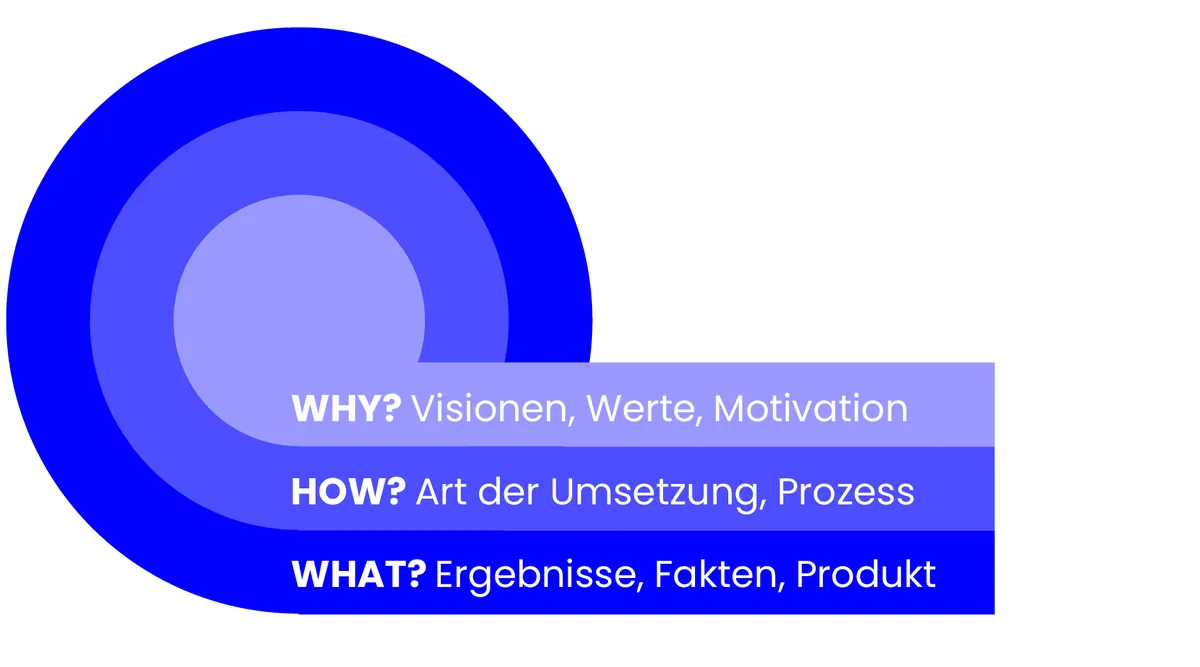
Graphically, Sinek’s Golden Circle model can be shown as three concentric circles that reinforce each other from the inside out. This can also be compared with the circles a stone makes when it hits a smooth surface of water. The questions partly build on each other.
Why
Why you should never stop asking about the purpose
What drives you? What do you believe in? The answer to the question “Why?” is, for good reason, the most important point on which you should base your marketing efforts. As a manager, you also have to ask yourself these questions in order to be perceived as authentic. Your leadership has to be “credible”. You have to give your customers or your employees something that solves a problem. The advertising message should inspire action and credibly link the purchase to a higher purpose. It must not just be a banal purchase; buying exactly this product has to give the customer unique added value. If you believe Sinek’s theory, this unique added value appeals to the limbic system in the brain. It is no coincidence that this is also where decisions are made in the brain. So the question “Why?” – alongside a vision for your company – is at the beginning of a successful strategy. After all, you want to move as many people as possible to make a purchase decision.
How
How can you convince people of your company?
How do you work? Which processes differentiate your company? What makes you stand out among thousands of others? Every company has to find the right way here: whether digitalised, high-tech production or genuine handcraft with fine, sustainable materials. According to the Golden Circle, what matters is that you position yourself as clearly as possible. How do you achieve this? Sinek recommends explaining to your target group as convincingly as possible why your approach is the ultimate way to reach the goal. The right advertising helps, informing people about what sets you apart from your competitors – whether the most modern technology, the best customer service or unbeatable prices for real quality.
What
Probably the simplest question: what does your company do?
You will surely be able to sum up enthusiastically in a few words what your core business is and why your company does well what it does. Whether products or services, describe as precisely as possible what “good you can do” for the customer. This is part of a good strategy.
Here, too, Sinek has something to say, because he assumes that the “What?” question is probably the least important, as it ultimately builds on the two previous questions. This question contributes less to decision-making than the first two. According to the Golden Circle concept, the “What?” question appeals to the neocortex of the brain, which is responsible for rational thinking. But this does not mean that you should not make an effort when answering this question. Make your brand purpose (the meaning and purpose of your brand) clear and so differentiate yourself from your competitors.
Are there alternatives to the Golden Circle?
Yes, there are! A similar model is the “Brand Benefit Ladder”. It is also known as the benefit hierarchy check. Like the Golden Circle, this concept aims to convey to consumers, as part of your strategy and vision and through psychological influence, that they need your product. It assumes that you achieve greater customer reach and customer loyalty if you manage to appeal to your target group on an emotional level. The same applies to all topics concerning leadership. In this context, we are then talking about your employees. The Brand Benefit Ladder gives you the chance to look at your brand through your customers’ eyes. This lets you find out whether your product or service meets your customers’ emotional needs, and adjust it if necessary.
The Brand Benefit Ladder is closely based on Maslow’s hierarchy of needs. This states that a brand must first satisfy basic needs before it can climb further levels. At the top of the pyramid is a social benefit that has to be achieved. If you decide to apply the Brand Benefit Ladder to your organisation/product, you can answer the following questions as part of your strategy:
– Which product features do we offer that bring benefits to our target group?
– Why should our target group be interested in our products?
– How should customers feel when they buy our product?
Conclusion on Simon Sinek’s Golden Circle
Both systems deal with the marketability of your product and/or your company, with the Brand Benefit Ladder going into somewhat more depth and examining further sub-areas. Both concepts also look closely at leadership, strategy and vision.