How disruption changes the market for good
What is disruption? And what, then, is disruptive technology? And does every idea really have to be an innovation?
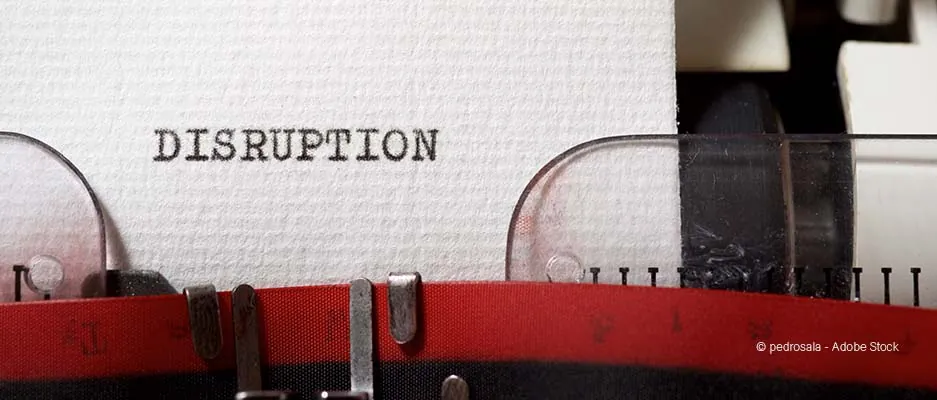
In recent years, there have been more and more headlines such as “Progress is making us unemployed”. These articles spread panic that progress, especially artificial intelligence, will soon revolutionise our economy and make many professions redundant. You may also have wondered whether your profession or your company will survive in the future. In general, fear is not a good motivator for doing a job or running a company effectively. Here you can find out what disruptive technology is and why you should not be afraid of it.
What is disruption?
Disruption describes an economic development in which an existing business model or even an entire market is replaced by a dominant innovation. The term is derived from the English verb “to disrupt” (“to destroy” or “to interrupt”). Today, disruption is often associated with the upheaval of the digital economy. Digital innovations are increasingly replacing traditional technologies, services, business models or products and revolutionising ways of working. In the start-up community, the term “disruption” is very popular because it stands for innovative thinking that changes the world.
As a rule, disruptive technologies are not yet successful at the beginning, because they still need to be perfected and consumers first have to understand and accept the product. But as soon as the innovation becomes established, it shapes the market for good.
The smartphone as the epitome of disruption
For conservative people who like to hold on to the status quo, disruption can be perceived as purely destructive, because it often replaces familiar business models. But a technology that is disruptive does not always have to destroy a market completely; it can also change it fundamentally and expand it. A very striking example of this is the smartphone. It has radically changed our everyday lives. We do not just make calls with our smartphones; we listen to music, plan our week with digital calendars, navigate to our next appointment with maps, read the newspaper on them and take pictures of our holidays. In this way, the smartphone has largely, but not completely, replaced simple keypad phones, MP3 players, paper diaries, maps, print media and digital cameras.
Some paper diaries are still kept for nostalgic reasons or for a better overview. Some maps are still stowed in cars because reception could drop out or the battery could run flat. The paper newspaper is also sometimes still read with pleasure, as a way of doing a digital detox. Professional photographers still rely on SLR cameras.
The licensed brand Nokia as an example of how disruptive an innovation can be
With the launch of the iPhone in 2007, Nokia was too slow to respond to the associated rise of the smartphone as the epitome of disruption in the 21st century. For what was the world’s largest mobile phone manufacturer until 2011, this meant a dramatic decline in the industry and ultimately the sale of its mobile phone division. Nokia then initially concentrated on its network business and map services. In 2016, the licensed brand Nokia returned to the mobile phone business under HMD Global. Only recently, in 2022, HMD Global won the lucrative contract to supply Deutsche Bahn with 12,000 Nokia smartphones and 15,000 tablets. This makes Nokia a very good example of how a business model can first be destroyed by a disruptive technology but then successfully reinvented.
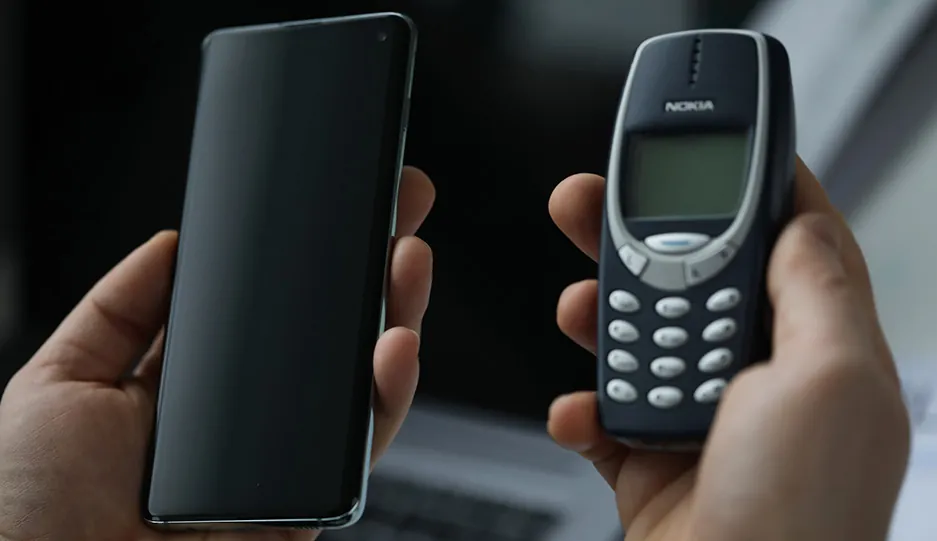
Image: megaflopp – Adobe Stock
Why does disruption cause both worry and euphoria?
Of course, every company would like to bring an innovation like the iPhone onto the market that changes the world for good. But disruption causes not only euphoria but sometimes also fear. After all, it is not always easy to convince customers of a new product. In the spirit of: “I’ve managed without this product so far, after all.”
Photography is a good example of this. For the manufacturers Canon and Nikon, investing in the digital camera market was not lucrative at first. Their customer base of professional photographers placed great value on high quality and the best image resolution, which could not be achieved with the cheap, easy-to-handle digital cameras. Their target group was rather the hobby photographers who share their pictures on Instagram and other websites. A customer base that did not yet exist but first had to be convinced of the product. For companies, this means that they first have to invest money and then hope that their innovation will be successful – perhaps even disruptive.
What makes a technology disruptive, and when is it “just” innovative?
Innovations are inventions and ideas from different industries that are initially intended to bring renewal or improvement. This means that existing products or services are developed further. Disruption only applies when products, markets or companies are partly or completely replaced. The scale of the restructuring is therefore different. Whether a product is a normal innovation or even a disruption therefore has nothing to do with product quality.
Conclusion
Why disruption need not cause fear
It is a fact that artificial intelligence will change our working world for good. How disruptive the effects of AI on different industries will be remains to be seen. What is certain is that no AI will replace all industries. Robots may soon take over helpful tasks in care; but they cannot provide emotional, empathetic support. E-books may be practical bestsellers, but they will still not stop a bookworm from enjoying the smell of freshly printed letters in a bookshop. There are always certain products and services that remain irreplaceable. In the end, the following applies to all business owners: keep yourselves informed about innovations and stay open, then you won’t be left behind either! And if you are, the Nokia brand will hopefully remain a comforting reminder. Because you have both the option of focusing on another line of business and the option of making a late fresh start!