Save time with the Pareto principle
Ever heard of the Pareto principle? Then it is about time! Pareto helps you work efficiently and understand what matters.
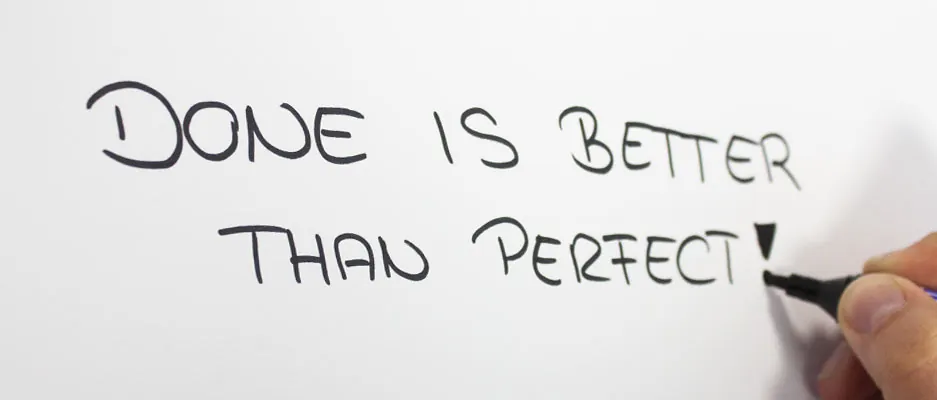
Good instead of perfect – work more efficiently thanks to Pareto?
Have you ever heard of the Pareto principle (opens in a new tab)? People often follow this rule without really knowing that they are applying this principle. We all know those unpopular tasks that are part of our job and that we know in advance will hardly affect the result. Nevertheless, they get done so that we can complete our own checklist perfectly. But what is the Pareto principle in the first place, what is the idea behind it, and how can you use the effect sensibly or question your own work?
The history of the Pareto principle
Who invented it? At the beginning of the 20th century, Vilfredo Pareto, an Italian engineer, economist and sociologist, found that 20% of Italians owned 80% of the national wealth. His logical conclusion was that a bank could serve 80% of its customers in just 1/5 of the time. In concrete terms, it is about achieving 80% of the result with only 20% of the effort. So if you strive for perfection, you still have to face the biggest challenge in terms of effort.
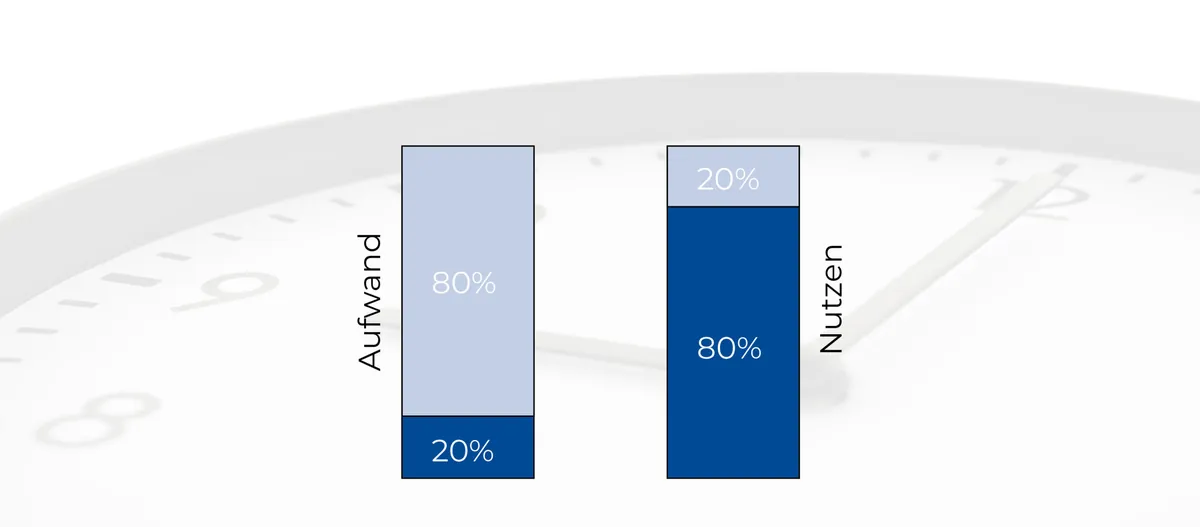
Some examples of the Pareto principle:
- 20% of websites are responsible for 80% of data traffic
- you make 80% of your turnover with 20% of your customers
- 20% of people own 80% of all wealth
Definition of the Pareto rule
If you set your priorities correctly, you only have to consider what really needs to be done and what instead falls into the category of “wasted time”. Pareto is therefore ideal for process adjustments. Which workflows can be made leaner without throwing the result overboard? What is important and what is not? The 80% and 20% split is of course a rough rule of thumb that you can act on and use to question your to-dos.
Pareto = setting priorities
A good knack for time management is essential if you want to be successful in your job. You have to be able to set priorities by sharpening your focus on what really matters.
After all, as an entrepreneur you want to work as efficiently and productively as possible. Very few people have too much time. It starts with the supposedly small things, e.g. writing and answering e-mails: surely you can fit 80% of the content into 20% of the e-mail? What about discussions and meetings? Do you really need to spend an hour coordinating, or have the key points been made after just a few minutes?

Nobody is perfect
Doing everything perfectly means putting in a lot of energy and time to reach that high standard. But the question is: is it really necessary? That depends on the individual case and is not universally true.
But it makes sense to ask yourself this question again and again before you set off and get down to the tasks.
Not approaching the tasks with perfectionism does not mean that you should do your work badly.
You should simply make things easier for yourself.
The aim is to be able to apply the principle spontaneously and get the best out of each situation. Applying this principle is an instructive therapy for every perfectionist. They notice that full effort is not always needed. For example, under time pressure the design of your presentation can be simpler and the talk will still make a really competent impression.
In some areas, by the way, optimising for efficiency is out of place. If, for example, a traditional bakery decides to bake only its best-selling pastries at Christmas, word of the lack of variety will quickly get around.
How efficiently do you work?
A difficult question – I know. Here are a few examples on the topic of “searching for information in the company”:
- How much time do you spend every day searching for e-mails and documents because the way things are organised allows nothing else?
- How much time goes on checking with colleagues to find out the current status of a prospect, customer or project?
- How many notes and sticky notes with important information are lying on your desk that are relevant not only to you but also to your colleagues, forcing them to take up your time so that everyone can carry on working?
- You already have no time, but you have to stand in for a colleague who is on holiday?
Do you want to work more efficiently?
We can support you “perfectly” with our solution infra-struktur 🙂