Meeting tips: 5 steps to a productive meeting
A meeting should be productive, intelligent, well arranged and cleverly implemented. Only then is it a successful meeting.

A meeting is a fine thing …
… you exchange information, discuss ideas, check current projects, develop strategies, set priorities and assign tasks – and at the end everyone involved leaves motivated.
What? That doesn’t sound familiar?
– Not to most participants either.
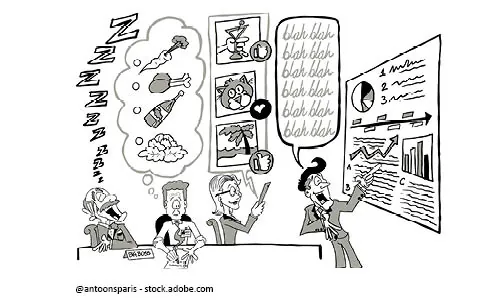
Because in reality, boredom usually prevails at meetings. There is a lot of chatter, little is said, and at the end it remains unclear what the whole thing was supposed to be about. On top of that, the day is gone and the real work is left undone.
But there is another way: productive, intelligent, well arranged and cleverly implemented. That is exactly when meetings really deliver what they are actually meant for: productive exchange, concrete decisions, projects moving forward and satisfied participants who actually leave motivated.
How does it work? Voilà:
Five simple steps to a productive meeting
1. Prepare the meeting – but with a plan, please
Find a free slot, send the invitation and you’re done? Far from it!
The be-all and end-all of a successful meeting is preparation: in terms of content, strategy and technology.
The first question could be:
Is the meeting really necessary? What exactly is it about? What is to be achieved and how do we get there?
If you cannot answer any of this, the meeting can very probably be dropped. Otherwise, follow these steps:
Create an agenda
Which topics are planned? Under each point, outline the status quo of the matter. This is followed by the goal of the agenda item, ideally including proposed solutions. Plus: who is responsible for the topic, what information/documents does this person need and how much time is planned for the topic? Once all points are listed, point out any preparation you would like the participants to do.
If you are not the host but are invited to a meeting and do not receive a concrete agenda, feel free to ask for one. After all, you want to prepare. If that comes across as a broad hint – so much the better.
Decide on participants
While you create the agenda, it becomes clear which participants it actually makes sense to have there. These are people who can contribute or need information, people who make decisions and those employees who are likely to carry out the next steps.
On closer inspection, a third fewer people are on the list than originally planned? No problem, they certainly have enough to do elsewhere. The success of a meeting does not depend on the number of participants, but on having the right ones. There are probably also a few people whose presence only makes sense for some items. You should bring these topics forward and reduce the group once everything on them has been discussed.
Inform and involve participants in advance
Once the agenda and the adjusted number of participants are fixed, ideally send it out well in advance. Involve the participants beforehand by asking them to add to the agenda if they feel something is missing. It is also wise to point out that, in everyone’s interest, the status quo already outlined for the agenda items will replace a lengthy introduction at the meeting. Perhaps adding that, for this reason, the meeting will be a quarter of an hour shorter than usual.
Vary the format and length?
In general, it is worth considering changing the way meetings work towards a possibly more productive model. In the fishbowl method, for example, an inner circle of chairs is formed. It holds those directly involved in the current topic as well as one empty chair. The outer circle of chairs is occupied by those who are not actively involved in the item. If they have ideas or other contributions, they can temporarily move to the empty, active chair. The length of a meeting is not set in stone either. With systematic planning and consistent execution, it can often be reduced considerably. Quality over quantity.

Technical preparations
A lot of time is wasted on failing technology. That demotivates and tires people, and the initial momentum of those present dries up. So: check all devices in good time before the meeting. Plus: is the room big enough at all? Sufficient distance or freedom of movement and fresh air are not only important in times of crisis.
2. Starting the meeting
Did you use to wait for latecomers and waste valuable time? That stops now, otherwise it will go on like this until kingdom come. In other words: the meeting starts on time. First of all, agree who will take on the role of timekeeper and minute-taker. You can also mention this point in the agenda to avoid long debates on the spot.
Because of the boredom and lack of productivity that have so far prevailed in far too many meetings, it is almost normal to tap away on your smartphone, play games or take a relaxed nap during them. No wonder, because you cannot expect enthusiasm from mediocre presentations. But mediocrity is a thing of the past: feel free to mention briefly that there is a fresh breeze blowing here, that this is exactly why you sent out a concrete agenda and that focused participation is required. And that the results benefit both the projects and everyone involved.
3. How the meeting runs
The participants are pleased, curious and hopefully highly motivated to finally stop wasting time on pointless meetings. Now it is a matter of sticking to a clear line.
Speak convincingly & encourage participation
As the moderator, you play a key part in making people feel addressed. Speak vividly, with variety and creatively! Do not be afraid of metaphors and wordplay, be authentic and bring people along with you. You should avoid empty phrases and monologues.
Of course, there are always participants who hardly react outwardly. But it is often the introverts in particular who would have quite a lot to say.
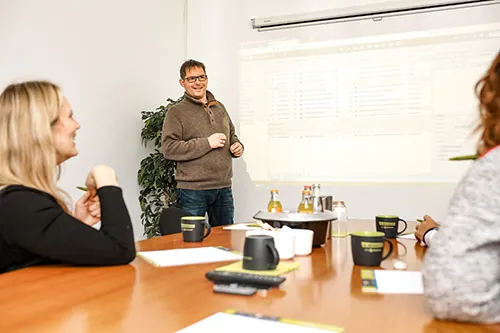
Encourage them specifically, but do not favour them. Be human and approachable, but do not lose sight of the matter at hand. Sounds exhausting? It is not. Tensing up and trying to appear super confident – that is exhausting and otherwise ineffective.
… and if the debate gets out of hand?
If there are signs that you are losing the threads and the conversation is drifting off, throw out a lasso and bring people back to the topic. Remind them of the purpose of the individual agenda items and of the respective time slots.
However, digressions sometimes bring up content that is quite valuable. From now on, there is a topic store on a whiteboard for this, to be dealt with later. That way, no clever ideas are lost and the meeting still stays within the planned framework.
4. Ending the meeting and follow-up
Start on time, finish on time. Thank the participants for their attendance, their commitment and their contributions. Hopefully you have planned enough time for yourself to finish the notes in peace, together with the minute-taker if necessary. In them, list the points that remain open as well as additions. The participants receive these notes promptly with a request to give any feedback by a set date. Perhaps thank them again for the successful meeting – positive feedback spurs people on and strengthens the feeling of all pulling in the same direction.
5. Reflect & optimise
So, how did the first meeting under new resolutions go? It makes sense to reflect on the process and the insights for yourself. Ideally in writing. What worked well, what was less well received? What would you still like to fine-tune, which methods could you also include and what already went perfectly? You can also ask the participants exactly these questions in the following days. Because you grow with your tasks – and best of all together.