GTD – Getting Things Done
Getting Things Done (GTD) is a self-management method by David Allen that helps you work more productively and not forget anything.
Reaching your goals with Getting Things Done: a productive method for all areas of life
Oops, there was something! Do your tasks come back to you at the last minute or sometimes far too late? You wanted to talk to your customer about last Friday’s quote, but it completely slipped your mind during the call? Do you think about upcoming tasks and preparations for appointments days in advance (and again and again)? Don’t worry, you are not the only one weighed down and overwhelmed by too many tasks.
A good approach to getting on top of the situation is Getting Things Done (opens in a new tab).
What is Getting Things Done anyway?
Getting Things Done (or GTD for short) is David Allen’s self-management method.
The goal: to clear your head and still work efficiently and without stress.
The GTD method is based on improving how you handle daily information and the tasks that result from it with context-based task lists. This gives you both a view of different topics and control over your workflow. All you have to do is record all pending actions in a structured way, freeing your head for more important things. Thanks to this structured organisation, your head can be sure that nothing will be forgotten. You can concentrate better on tasks that are currently relevant and relax completely during rest periods, because nothing else is buzzing around in your head.
With GTD, you break larger tasks down into smaller subtasks for which you set specific deadlines. Regular reviews ensure that you keep an eye on all projects and tasks, identify weak points in your system and make improvements.
The Getting Things Done workflow
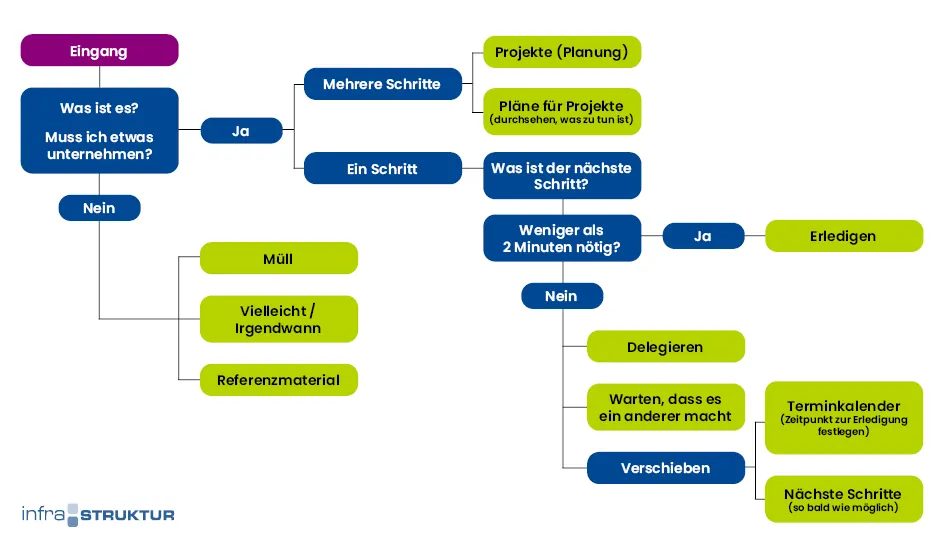
Collect
Collect all important information in as few places as possible.
Examples: e-mails, call notes, tasks, documents, messages from colleagues.
In the GTD method, all this information is regarded as the “inbox”. In the sense of “which e-mails, tasks etc. have come in and need to be dealt with”.
Process
Decide what to do with your “inbox”. Do you have to, or can you, do anything at all? If not, e.g. an advertising e-mail, get rid of it.
Is the answer YES and can you deal with the matter in 2 minutes or less? Then do it!
Otherwise you will come back to this actually small matter of just 2 minutes several more times, and in the end it will quickly turn into 20 minutes.
Organise
Do you need several steps, and certainly more than two minutes, to complete the task? Then organise these steps in a separate project. Components might be, for example:
– Calendar: arrange an appointment with Ms Mayer
– Waiting for feedback: clarify technical details in-house with your colleague Sven so that you can prepare for the appointment. Has Sven already given you the information?
– Maybe later: ideas and things that could become relevant at a later point
Get an overview
Check regularly that everything is in order. Look at your inbox lists and your calendar every day. Once a week, you should also do a weekly review: check appointments and follow-up work, tick off topics that have been successfully completed, define the next steps for each project.
Get to work
You need to be aware that GTD distinguishes between three types of work:
1. Planned work
2. Unplanned work
3. Defining work
With Getting Things Done, you should spend most of your time on planned work.
To decide correctly what you need to do next, your planning must be based on the following criteria:
– Context
– Energy
– Time
– Priority
Four lists of the GTD method
The GTD method is based on four lists. They can be managed particularly easily and efficiently with the help of software.
Action lists
On this list, the “next steps” are worded in such a way that the associated task can be started straight away without thinking about it again (e.g. “Find documents in the office” instead of the broadly worded task “Do tax return”). Depending on the number of tasks, it makes sense to organise the following actions separately by context. David Allen recommends calling them up according to the resources needed to carry out the tasks. Suitable names for context lists are, for example, “Phone”, “Internet” or “Car”. In a weekly review, all lists are checked and updated.
List of projects
All projects come together and are recorded here. Projects are tasks that cannot be completed within 2 minutes or in just one step. If possible, a GTD project should be worded in an appealing way.
Calendar
Appointments are recorded in the calendar. Only time-specific tasks (appointments, e.g. meetings), day-specific tasks or time-related information (e.g. birthday reminders or hotel information for business trips).
Waiting list
An important element of GTD is that, at the start of the workflow, it is checked whether the activities can be delegated. In that case, the delegated task is entered in this list.
Implementing GTD starts with recording all open loops. According to David Allen, these open loops include all actions, goals, projects and commitments that have not yet been carried out. All “open loops” are recorded and integrated into the system.
Conclusion: Getting Things Done helps!
Getting Things Done is a self-management method that is easy to put into practice. Numerous users have confirmed this in their success stories. People who appreciate the analytical and structured approach of GTD and have long been clear about their priorities and goals can benefit from the method in particular. Anyone who is entrusted with various tasks gets practical help with a system that can be used for better task planning and organisation.
Using Getting Things Done in practice in your company
GTD is an established method for clearing your head while not forgetting anything. Like David Allen, we rely on managing everything centrally in one system so that the whole company is up to date. This way everyone can organise themselves quickly and easily and never lose track. Our solution infra-struktur was even developed partly on the basis of the GTD method.
infra-struktur for more Getting Things Done
Find out more about our GTD software and how it simply helps you get more done while keeping your head clear.