8 methods for better time management
How to expose time wasters in the office and significantly optimise your time management. Master tasks in an organised and structured way.

How to expose time wasters in the office and significantly optimise your time management
Do you also often ask yourself at the end of the working day where the time has actually gone and what the productive result of the day actually was? Internet, phone, e-mails, countless notes and documents are lying on your desk. In everyday working life, time wasters that keep us from working in a structured way lurk everywhere. There are simple methods to improve your time management. With the help of simple tips, learn to organise yourself better, work with more focus and ultimately enjoy your work more. Modern office management and customer management systems can save you a lot of time, because you can concentrate on what matters. Only when you are well organised can you look forward to lots of “green ticks” on your to-do list at the end of the day 🙂
1. Work in blocks
A recent study has found that working on one topic with focus is considerably more efficient than tackling everything at once.
Tips for your everyday work
In your daily plan, for example, set fixed times for dealing with e-mails, calls and project work, and stick to them strictly. Don’t let the “ping” of a new e-mail in your inbox keep tearing you away from your work. Turn off sound alerts or share your e-mails with colleagues for a defined period.
2. Store information centrally
Modern office management and customer management systems give you the convenient option of organising all communication with your customers, suppliers, projects and so on in digital records. In these digital records, all important information about your contacts is stored in just one central place.
Frequent queries to colleagues – especially about e-mails and calls – are no longer needed.
Why? Because all e-mails and calls, including the phone note, are automatically saved in the right contact history, because that is exactly where they belong.
But documents, appointments and tasks also need to come together centrally to make your time management, and of course that of your colleagues, easier and more effective.
Endless searching and combing through file and note storage, servers, PCs and e-mail inboxes, including folders and subfolders, can easily be minimised… everyone just needs to know where to find which information again with two clicks.
3. Create transparency
A digital contact history provides a clear, chronological list of who discussed what with whom, when and how. All colleagues have access to these contact histories according to their permissions. This way, Mr Müller, who is standing in for his colleague Mr Schuster who is unexpectedly absent, can give the customer information about the last e-mail enquiry just as competently as Mr Schuster himself. After all, customer service and customer care depend precisely on being helpful regardless of who the actual “contact person” is.
Working transparently not only improves time management for everyone in the company but also ensures faster response times. Employees and customers are satisfied – what more could you want?
4. Introduce a company wiki
Store recurring tasks and internal processes, such as the instructions for travel expense claims, onboarding new employees, holiday requests etc., in a company wiki. This way you provide “help for self-help”, and your colleagues can work through the instructions on their own.
5. Reduce the paper chaos
Break up knowledge monopolies and start a new kind of transparent company communication, in which every employee shares their knowledge with all their colleagues so that you become more productive together.
Notes on calls end up, if at all, on just one desk or stay in the head of the person who has just been on the phone. Quickly digging out these notes weeks later or remembering the call 100% certainly does not turn out to be the best solution. With digital notes in the right contact histories – not only on phone calls, of course, but also on meetings, appointments and so on – you make life much easier for yourself and your colleagues.
6. Create and share tasks
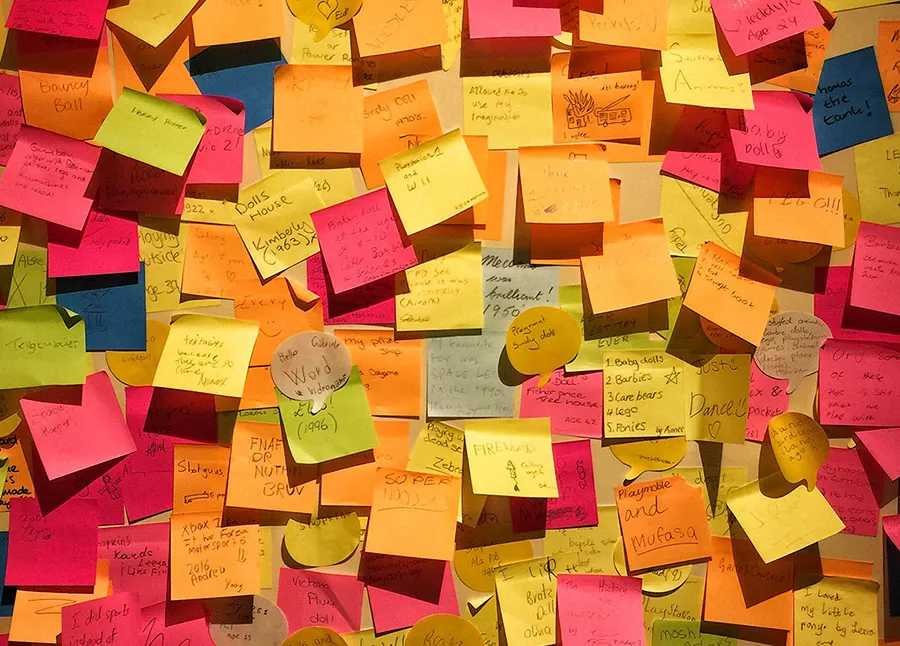
Time management and keeping track of current tasks go hand in hand – yet central organisation is often lacking. Tasks stay in people’s heads. Do you push unread mails into impenetrable folder structures to deal with later, use the surface of your desk and monitor for lots of little yellow sticky notes, build Excel spreadsheets, pass on callback requests verbally to colleagues, all to keep track in the end?
The most important point by far for planning tasks and keeping them on your radar without getting bogged down is the direct connection to the source – the task must be linked to the source. It must be linked to the call, the mail, the document, the meeting, the contact, the project etc. Task management without a concrete connection to the source, which you must be able to reach and follow with one mouse click, is in the end just another pretty new list.
Or to look at it another way: if you share a task with colleagues, it must be as self-explanatory as possible so that your colleagues do not have to work their way into it laboriously.
7. Create uniform structures
Why are many things not structured as well as they could be? Quite simply, because we don’t know where to put the wealth of information. So you can only organise information in a structured way if there is a clear, central structure that is the same for everyone. Otherwise it is hard to work on time management.
For example, create digital project records to which you link sketches, notes, documents, e-mails etc., so you can find them again easily. You can also link your project to a customer, supplier or other contacts. This way, not only you but also your colleagues will find all the information on the project straight away.
8. Plan your day and your week
Studies show that you can only reduce negative stress (so-called distress) through physical exercise. Any claim that watching TV or listening to music has the same effect has not been proven. In today’s technology-based world, however, the following has happened:
a) Many people are constantly working at their limit, because our “performance train” is simply going so fast and because nowadays it seems you can only score points if you work 60 hours at a stretch and keep a camp bed in the office.
b) We hardly move any more. We drive to work, we use the lift to get between the floors of the office building – unless we sort everything out by e-mail or phone – and the printer is right next to the desk.
Surveys have also shown that most employees always decide in favour of their work and against their private life. People would rather do one more work task and give up time in their private life for it.
infra-struktur – your digital workplace
With infra-struktur you create a digital workplace tailored to you and your most important topics. This makes your time management child’s play.
Conclusion – why time management is important
Our “stress silos” fill up and eventually collapse. The rising number of burnout patients proves this development.
Our tip: plan breaks and private appointments in your weekly calendar with the same importance as work appointments. Commitment increases many times over when an appointment is in the calendar. Otherwise there is a risk that others will plan your free time for you. Make sure there is a balance between working and taking breaks => this makes you more productive, and that is what it is all about, after all.