Informal learning: what it is all about
We learn most things at work not through training courses and further education, but through informal learning. But what is it all about?

Informal learning is the opposite of formal or institutional learning, that is, the teaching of knowledge in institutions such as school, a university, during vocational training or at a further education institution. Informal learning is about processes such as training on the job and learning on your own initiative.
Changed conditions call for a new way of learning
Both types of learning have their place. But informal learning, or learning and training on the job, has been becoming more and more important for years. It is assumed that around 80 per cent of adult learning takes place informally.
This constant learning is so important because conditions change much faster today than they did ten or 20 years ago. Today it is more important than ever to stay on the ball and keep learning new things. This applies above all to fast-developing industries such as IT and software development, and to all areas that deal with artificial intelligence (AI). With AI in particular, information published six months ago can already be outdated and redundant today. Find out in this article what informal learning is all about, how you can benefit from it and what advantages and disadvantages it brings.
Definition of informal learning
Informal learning is involved whenever the learning content is not linked to a structured, set curriculum and is not tied to fixed requirements of place or time. It is about learning in a practical context. This includes learning by trying things out in practice (learning by doing, training on the job), learning from a model, that is, by observation, and learning through feedback and reflection. There is no report or certificate for informal learning, only the personal gain in knowledge.
All information in one place
Your digital workplace brings all parts of communication together in one system and collects the information into a complete contact history.
Which skills can be acquired through informal learning?
In principle, anything can be learnt informally today, and the opportunities are more varied than ever. Informal learning includes, for example, a conversation with a colleague from another department who shares some of their knowledge. Reading an article in a magazine can be informal learning, as can watching a video tutorial. When you read instructions or a book, you are learning informally. Visiting a trade fair or a workshop also counts.
The 70-20-10 rule and the thing about seminars
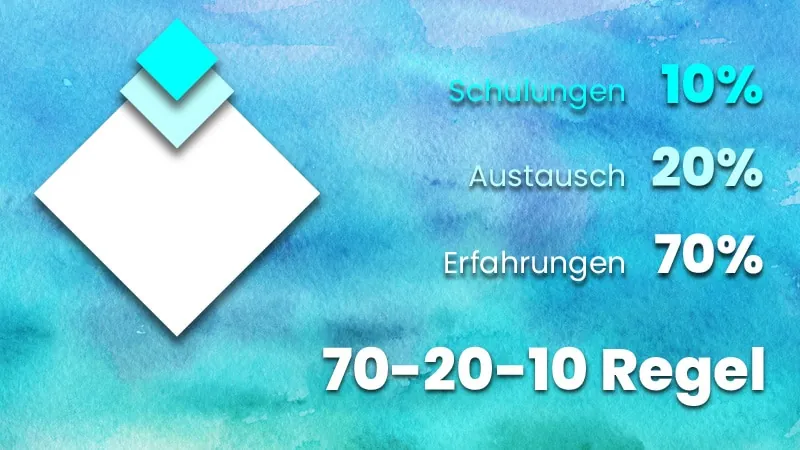
When it comes to developing employees’ knowledge and teaching them new things, HR managers should follow the 70-20-10 rule. Studies show that employees learn 70 per cent from their own experience at work. 20 per cent is learnt through interaction with colleagues and only around 10 per cent through formal training. These figures show how important informal learning is and how small the contribution of institutional forms can be in everyday working life. In view of this, the question arises whether classic seminars at work still matter.
If seminars are aimed at a clear target group with a defined training need, they still matter. Often, however, the problem with seminars is that further training is handed out indiscriminately and employees cannot apply what they have learnt directly at all. Since seminars involve high costs, HR managers should always keep an eye on costs and benefits. Seminars or training courses are always a good way to get started in a new subject area.
The advantages of informal learning
The greatest advantage of informal learning is how close it is to practice. After all, employees learn exactly what they need for their work. It is not about abstract concepts or lofty theories, but about what is needed for a successful working day. In sales, for example, you learn best by looking over the shoulder of a successful salesperson and picking up a few techniques or identifying success factors. In a trade, an apprentice learns best when the master craftsman, with all his experience, shows him how to work a particular piece. The fact is: you learn best when you can apply what you have learnt directly and solve concrete problems. If there is no link to daily work, what you have learnt is often quickly forgotten again.
Informal learning is free. When knowledge is passed on within the company, there are no trainers or expensive hotel stays to pay for, and employees are not away for days on end. The sessions are usually short and to the point and arise naturally in daily work.
The disadvantages of informal learning
A major disadvantage is that there are no certificates or proof with the informal type of learning. If, for example, you want to change employers, you cannot prove what you have learnt informally in your current position; you can only back it up with examples. Informal learning is not subject to any control of the kind found in schools or universities. The quality of the knowledge is not checked. It can also happen that incorrect information is passed on or that suboptimal practices become established in a company.
Informal learning takes initiative. Some people only learn when they have to, and find it hard to learn of their own accord. Or they do not dare to ask colleagues. This is where companies can take action to create a culture of openness, inform employees about the concept of informal learning and encourage it. Examples are brown bag sessions, that is, informal meetings at lunchtime in which a particular topic is looked at more closely.