5 why method: why you should ask 5 times
With the why method, you take up the questions that children love to ask: why & what for? Work your way from the problem to the cause and the solution.
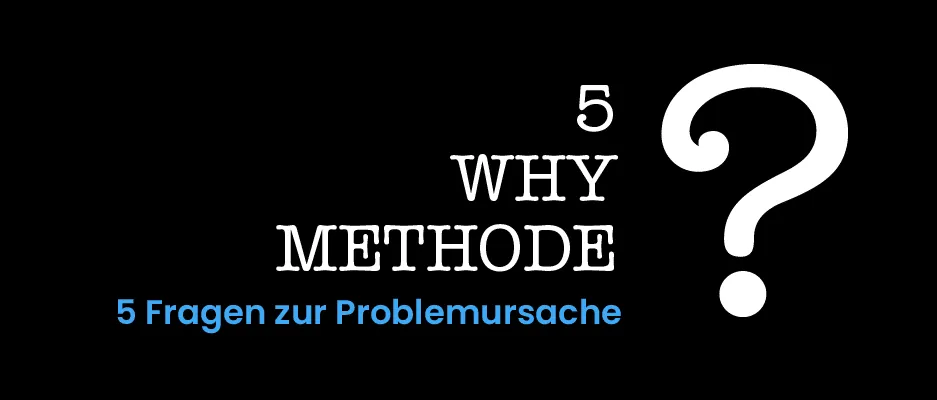
Problems in a company need a quick solution. But first the cause has to be known so that the right measures can be taken. This is where the 5 why method (5W method) has proved helpful. It is a proven questioning technique from quality management, for getting to the heart of a cause. Only when we understand cause and effect can a problem be solved for good. We keep asking why until the cause has been found. The number 5 has a rather symbolic meaning, because it is perfectly fine to ask more than five questions. Because of the high pressure of competition, customer satisfaction has to be very high so that customers do not move to the competition. Products are interchangeable, and companies cannot afford repeated mistakes.
Children often ask why and what for, and are only satisfied when all their questions have been answered, because this is how they want to get to the truth. Even if it gets on our nerves as adults, this is a brilliant way for little ones to gain new knowledge. Companies can take advantage of this by building this questioning technique into their quality management. As soon as a mistake comes to light, the cause is identified with the five why questions. The idea originally comes from Japan, from Toyoda Sakichi, the founder of Toyota Industries Corporation. He wanted to find the actual fault in defective automated looms as quickly as possible.
What is the 5 why analysis used for?
People should take the time again to observe something closely and draw conclusions from it. That is why it is important to describe the problem that has occurred first, before the right solution is found.
- What exactly happened?
- When did the case occur?
- Did it only happen with one customer or does it happen more often?
- What is a smooth process important for, and why?
- How did the problem come to light and who complained?
- Who discovered it?
- What effects did the problem have? Did we lose a customer because of it?
Every answer is followed by further why questions
With the W questioning technique, every level is then questioned. Each answer is followed by a new why question. This is how you get to the heart of the actual problem. It is a technique for feeling your way towards the chain of cause and effect. Applied to a car repair shop, for example, it could look like this:
The inspection service includes cleaning the vehicle. When it was collected, the customer’s vehicle had not been cleaned, and the customer complained about it.
Why was the vehicle not cleaned? – The master mechanic forgot to report that the repair was finished.
Why did the master mechanic forget? – Because he is currently working alone in the workshop and is therefore responsible for all cars.
Why is he alone in the workshop? – Because two master mechanics are missing in the workshop.
Why are 2 master mechanics missing in the workshop? – Because not all positions are filled.
Why are not all positions filled? – Because a job advert still has to be placed, but the employee responsible has been ill for weeks.
Here, the cause is the delay with a job advert. The master mechanic is overloaded and forgets to inform the service staff. This is a very simple example, but it reflects the core of this method.
The series of questions and answers often go in a different direction than first assumed. We have to make sure we narrow down the problem so as not to lose focus on it. So more than 5 questions are fine, but they should not go on endlessly either, because then we move away from the real cause. The important thing is to keep digging until the faulty process has been clearly identified and cannot be broken down any further.
The actual cause is uncovered
If we look closely, we can identify the actual cause and then take suitable measures. Our team can now work on a solution together. It is crucial that we get an accurate picture on site, because we cannot fully grasp the situation from our desk. It is important that we talk to the people responsible and discuss the matter carefully. In doing so, we should understand the importance of a smooth process and how it affects our customers’ satisfaction. However, we should be careful not to draw the wrong conclusions, because at first it is only about taking stock. As soon as the cause has been found, we have to fix it. We can do this, for example, with an action plan that also includes deadlines. Continuous monitoring and review are very important here to ensure that our measures are successful. It may also be necessary to carry out the review regularly, for example for maintenance work.
Don’t lose patience
Patience is needed here, especially when the cause is hidden deep in the system and a faulty routine has crept in over the years; it can take a while to find the right solution. People often stop too early, and then the problem comes back.
This technique is suitable for both small and large companies, because there are processes everywhere that need to be questioned. Large companies often create knowledge-based catalogues of errors and measures to provide a guide. This makes it easier to manage all the questions. With numerous extensions of the 5 why technique, even big challenges can be solved.

Where are the limits of the 5 why method?
What is this method less suitable for? The 5 why technique only ever deals with a single case, so problems that have several causes are harder to solve. Asking the right questions here takes a lot of experience and tact, because it can lead to blame and arguments. Other analysis methods need to be called on here.
Nevertheless, the 5 why method has many advantages, because it promotes communication and cooperation in the company. It avoids superficial solutions and makes rework unnecessary. Wherever effectiveness matters, we have to ask exactly why and what for, so that mistakes are avoided in future. Only then can we make the right decisions.
The technique can also be applied to many situations in private life to understand a lot of things better.