Destructive thinking and effective strategies against negative thoughts
Destructive thinking influences not only your behaviour but also the results of your work. It is up to you to think positively.
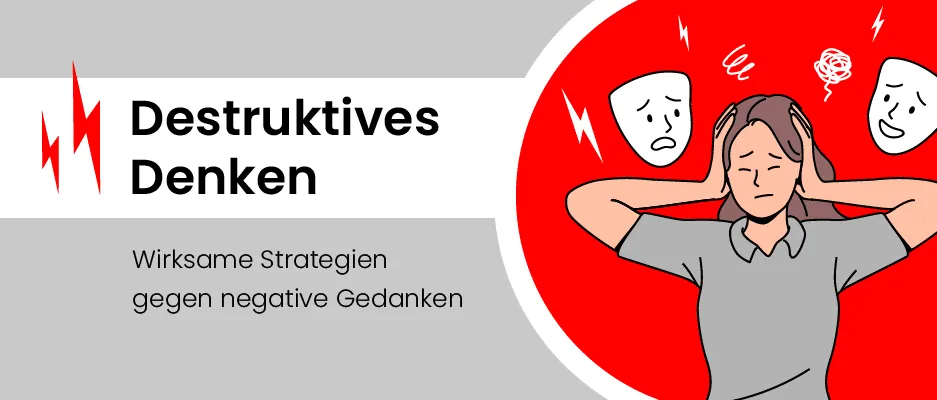
Brain research shows how much our thoughts determine us – whether we like it or not. Just think of the well-known example of the pink elephant. If your only task is not to think of a pink elephant: what will you think of? Exactly: a small, cute, pink elephant will walk up and down in your thoughts.
Our thoughts determine who we are and have a big say in personal success or failure. It is up to you whether you dwell on positive thoughts or devote yourself to destructive thinking. Very few people think destructively on purpose or do so to harm themselves. But unfortunately, many people repeatedly find their thoughts working in the wrong direction. This article looks at destructive thinking and how best to stop it and turn to positive thoughts.
Examples of destructive thinking
Destructive thinking is a way of thinking in which the mind is mainly occupied with negative thoughts. Examples are thoughts and sentences like the following:
– I just can’t get anything right.
– No matter how I work, I will never be successful.
– I will never find a job.
– My boss has it in for me.
– It was obvious that this would only happen to me again.
– Other people are always better than me.
– I’m sure I’ll fail at the presentation tomorrow.
– I will never manage to hand in the documents by the deadline.
Everything in view with infra-struktur
Your digital workplace helps you organise your work and achieve more every day without losing track.
Destructive thinking and its consequences
No question: everyone has a bad day now and then, and not everything works out straight away. Everyone makes mistakes; it is only human. But destructive thinking is about an inner attitude. If you dwell on negative thoughts permanently, sooner or later this will feel like reality to you and affect your behaviour. After all, the human mind cannot, or can only with difficulty, distinguish between reality and thinking. Destructive thinking can therefore literally lead to a self-fulfilling prophecy. If you think you will fail at the presentation, this will determine your behaviour and could end up happening.
Negative beliefs: the biggest traps for destructive thinking
Destructive thinking is often based on personal, limiting beliefs. They often go back to childhood. We carry these beliefs within us without being aware of them, because they are part of us. In the long run, these beliefs can weaken us inwardly and prevent greater success. Because the beliefs are deeply rooted in us, it is not always easy to track them down.
First aid for destructive thinking
You can actively do something about your destructive thoughts, beliefs and negative thought patterns and steer your behaviour in a positive direction. You do not have to stay stuck in the spiral of negative thoughts permanently. Here are the most effective ways to work against negative thoughts.
Stick a stop sign on your laptop
If you notice that you keep slipping into your destructive cycle of thoughts at work, stick a kind of stop sign in a clearly visible place in your office or directly on your laptop. This can help you stop the destructive thoughts early on without letting them overwhelm you completely.
Write yourself an emergency plan
If you notice that you keep drifting off into your destructive thoughts, plan ahead and write down what you are good at or everything you have achieved. You can read this positive list again and again and so programme yourself in a positive direction instead of staying stuck in your destructive thinking.

Talk to a friend
If you notice that you cannot get off your negative merry-go-round of thoughts on your own, call a good friend. They can surely remind you of the strengths and resources you have within you and take your mind off things.
Write down positive beliefs
It has proven useful to include positive beliefs in your emergency plan that replace the destructive thoughts, such as:
– I know I can do this.
– I am successful when I speak in front of people.
– I believe in myself and am up to the task.
– I deserve the respect of others.
– I have everything within me to master this challenge successfully.

Think of your role models
Everyone has people who inspire them and whom they look up to – in whatever way. Perhaps you have a boss whom nothing can unsettle, however hectic things get. Or there is someone in your family or circle of acquaintances whom you admire. Think of this person and ask yourself: how would they react? Would they bury their head in the sand, or how would they turn the situation into something positive?
Travel in time to your successful future
If you can only think about the upcoming presentation the next day and are afraid of it, travel in time to the future. Imagine how you mastered the presentation with confidence and how proud you are at the end when you look into the faces of your convinced audience. This thought automatically puts you in a positive mood and releases your resources.
Note: Everyone has phases when they lack motivation or destructive thoughts force themselves on them. Such phases usually pass. However, if you permanently suffer from a lack of drive, destructive thoughts or a feeling of hopelessness, these can be serious warning signs and you should seek professional help.