Walt Disney method – overcoming mental blocks
The aim of the Walt Disney method: more creativity, fewer mental blocks. How helpful is this strategy and how does it work?
The Walt Disney method – how helpful is it?
You have surely been confronted with this problem several times in your working life: you are sitting at your desk facing a problem, but you cannot think of any approach to solving it. No matter how long you think about it, brainstorm or try to get fresh input, the right solution just won’t come to you.
This is exactly the problem the so-called Disney method is meant to help with. However, it has nothing at all to do with funny cartoon mice; instead, it effectively promotes creativity, as various researchers have already been able to show. In the following text, you will find out how this Disney strategy works and whether it really delivers what it promises.
How does the Disney method work?
The Disney method is a fairly simple creativity exercise. You approach a problem from different perspectives and slip into different roles. A method comparable to the Disney strategy is the so-called thinking hats, introduced by the British scientist Edward de Bono. In this method, all participants put on an imaginary hat and take on different roles, which are characterised by different colours.
The Disney strategy works on a similar principle. Here too, all participants take turns putting themselves in different roles and looking at the problem from the perspective of their role. These are the three roles:
The dreamer
A role that always acts a little crazily and treads new, unconventional paths.
The realist
This role always acts very rationally and always thinks purposefully about how the idea can actually be put into practice.
The critic
The critic is comparable to the realist. They look at things soberly and act entirely according to the motto “better safe than sorry”.
Through their collaboration, these three roles set in motion an extremely effective process of generating ideas. The dreamer gives free rein to their creativity and does not worry about whether their first approach is feasible or not. The realist then approaches this idea in a somewhat more calculated and rational way and considers carefully whether it is a workable scenario, how high the costs are, and what benefit and purpose the whole thing has. Last but not least, the critic is brought in. With their analytical acumen, they check the details of the realist’s calculation. They give the idea its final polish and check where there is still room for improvement.
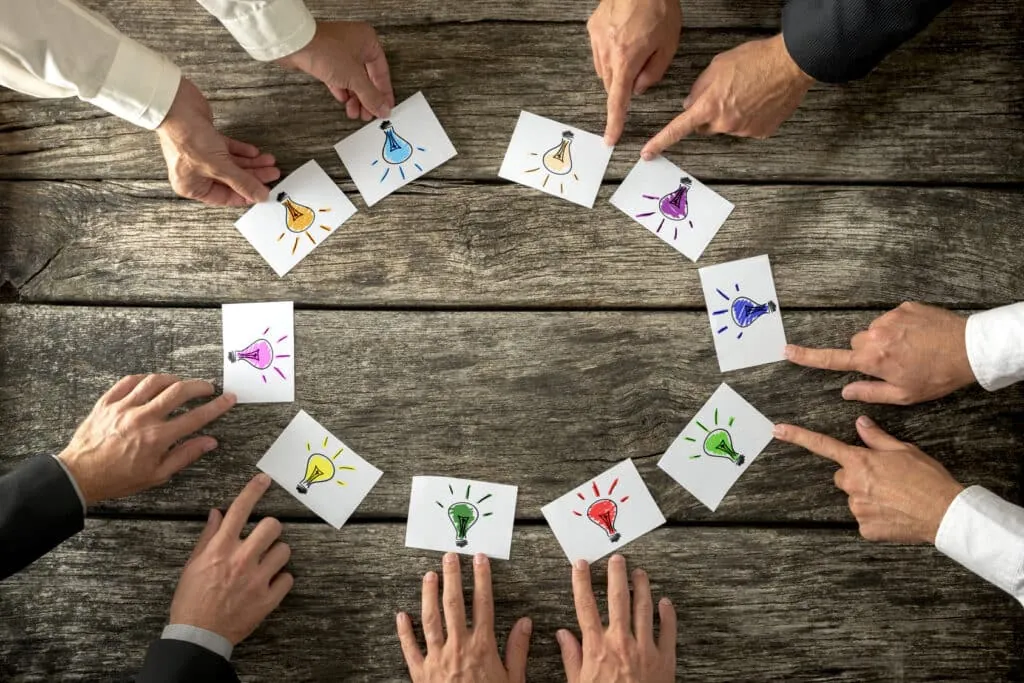
As you can see, these three different roles let you look at a problem from different points of view. Working together can turn a crazy idea into something genuinely viable and realistic.
This may sound a little unusual at first, and you will most likely not believe in how the Disney method works for the time being, but experts have already proved its effectiveness several times.
In which areas is the Walt Disney method effective?
As you can see, the Disney strategy is suitable both for individuals and for larger groups. The aim is always the same: new ideas should emerge and creativity should be encouraged. But the Walt Disney method is of course suitable not only for developing new ideas but also, as already mentioned, for solving problems. For example, the method can be used when developing a new business strategy or when making decisions on optimising business processes.
However, you should always bear in mind that the Walt Disney method does not automatically mean that you will create an earth-shattering, innovative idea in every case. It only serves to support and develop the creative thinking process. The method can, for example, serve as food for thought. But there is no guarantee that it will give you a revolutionary idea. In the end, that still depends on you and your team. Nevertheless, looking at a problem from different perspectives is usually very helpful.
Where does the Walt Disney method come from?
There are many approaches and myths surrounding the theory of how this method came about. Nevertheless, it is now generally agreed that Walt Disney, after whom the method is named, is not supposed to have been its inventor. It probably comes from the American author Robert B. Dilts, who was inspired by the creator of Mickey Mouse. In a book published in 1994 entitled “Strategies of Genius”, he stated that he had been inspired by Walt Disney and had named it after him for this reason.
The advantages and disadvantages of the Walt Disney strategy
As with everything in life, the Walt Disney method is of course not perfect. The method was developed in the early 1990s, and a lot has happened since then. For this reason, the first role of the Disney method, that of the dreamer, is quickly viewed critically today. The Disney strategy can deliver good approaches and develop its full potential above all in a group. Here, different characters come together who all put themselves in different roles, and new connections, impulses and ideas can emerge from this.