Supervision – an opportunity for your company
How can supervision help your team and solve problems at work throughout the company?
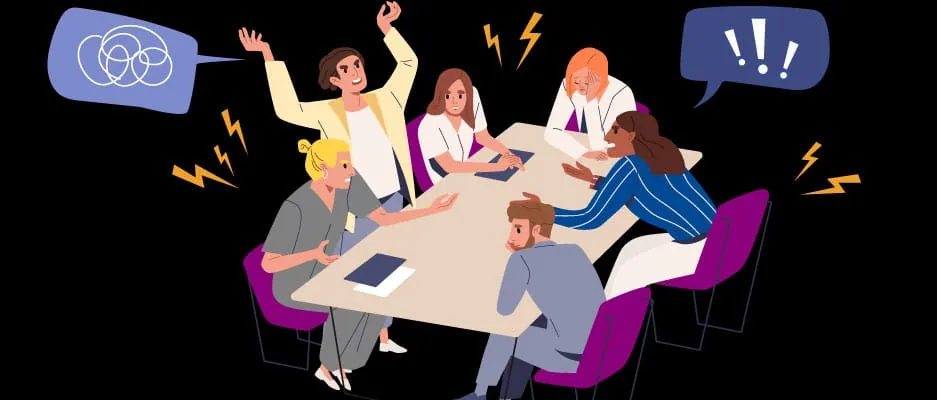
A problem at work keeps going round in your head and you cannot find a way out, because you are right in the middle of it, not only as someone affected but also as someone involved. A problem like this usually escalates or leads to a kind of explosion. That would be a solution – but not one that moves you and your team forward.
Have you ever tried to look at your problem from the outside? As if you were standing next to yourself and your situation? Only a few people actually manage this. The art of detaching yourself from being affected and, free of it, finding the way out of a conflict is hardly achievable – you are and remain part of the situation you want to change.
This is exactly where supervision comes in.
What is supervision?
Supervision is an instrument that makes analysis and self-knowledge possible. It supports the development of solution strategies. The literal meaning can be derived from “super”, the Latin word for “over”, and “vision” in the sense of “to look at, to imagine”.
Supervision can be used by employees as well as managers in various areas of the working world. Medical, educational and social institutions have already benefited in many ways from this form of conflict resolution and from improving everyday work, because what matters above all is that smooth work processes are ensured and employees stay healthy.
Employees usually act according to the requirements of their workplace and their tasks in the team. Disruptions considerably impair work results. If problems are not solved by those involved, supervision can help find solutions. Supervision does not intervene – it reveals where and how changes are necessary and possible.
Supervisors work as self-employed people or on a freelance basis. The costs are usually borne by the company.
The supervisor – what they can do
The supervisor circles above the situation and forms a picture of what you or your team present. This is easy for them, because they are impartial and unbiased.
The supervisor can look at the situation from a distance and discover connections that have so far remained hidden. This gives them the opportunity to see more clearly, with an unclouded view, where something is wrong.
With their professional help, they activate your ability to help yourselves in solving your conflict. They can set you on the path to positive change.
Supervision has to be learned
Whether through certified further training or a degree programme – supervisors receive the tools for their work in extensive training. They acquire skills that enable them to get to the bottom of other people’s difficulties. Supervision is also part of the training of a psychotherapist.
Supervisors have internalised that it is not their job to suggest solutions or to say how something must be done. They have the difficult task of guiding the supervisees to insights and a solution.
Supervision – one option among many
It can support an individual or teams in the company or its partners. It is helpful
- in dealing with conflicts
- in preventing conflicts
- in forming a team
- in achieving specific goals that have been set.
The aim of supervision is usually to improve operational processes in order to optimise the company’s performance. Supervision can uncover interactions that hinder work. It helps employees to behave appropriately in a difficult professional situation at work and to use their energy in a targeted way.
Successfully mastering stressful situations at the workplace benefits the individual and the company equally. The gain lies, on the one hand, in individuals using their energy sparingly and, on the other, in treating employees as a company resource in a way that keeps them healthy.
The right communication is what counts
infra-struktur brings all your business communication together in one system. This means that both internal and external communication run like clockwork.
The means of your choice
Supervision is available
- to you as a manager or head of a company as individual supervision
- to the members of a group as case supervision
- to an organisational unit as group supervision
- for the way people deal with and work with each other in the team as team supervision
.
The conditions for supervision
- The supervisor is impartial.
- You and your team trust their skills.
- You are willing to engage with the supervision.
- Everyone is willing to take an active part.
- Openness and unsparing honesty are the prerequisite for supervision to be successful.
- Dealings with one another are marked by respect.
- Letting others finish and listening are the basis for communication that leads to results.
- All participants are obliged to keep silent about the sessions outside them.
- The supervisor is bound by a duty of secrecy.

Supervision – the process
The basis is a contract between the client, the supervisor and the supervisees. It also sets out how long the supervision will last.
In preliminary talks, the plan and the possible result are worked out and formulated in a goal agreement. The assessment of the current situation is followed by the supervision process with constant reflection on events, practical implementation and monitoring of success.
The setting in each case is determined by the final goal to be achieved and the content to be worked on:
- In individual supervision, the conversation with the individual supervisee is the focus. The advantage here is the intimate atmosphere, which makes it easier to talk openly about personal behaviour, experiences and thoughts.
- Case supervision helps a group find solutions for improving the situation of a client, who is either not present or is involved.
- People from different areas take part in group supervision. Under the supervisor’s guidance, everyone takes turns to contribute their experiences and at the same time learns from the contributions of the others.
- In team supervision, conflicts within the team are worked on. The focus is usually on how people deal with each other, how employees work together, and the team’s norms and values. A particular advantage is that new insights can be put into practice quickly and success is possible soon.
The main focus of the objectives determines the methods of supervision. These can be, for example, conversations, observation of practical work processes or role plays aimed at analysing the team or the institution.
The supervisor follows the dynamics that develop during the process with the greatest attention. In developing the analysis, which they also prompt with suitable questions in individual or group conversations, they are guided by the agreed goals. With professional skill and competence in the method, they lead the supervisees to insights and to their own realisations, always aimed at their planned intention.
Role play – a method that activates experience
In supervision, role plays are often used to get employees or the boss to reflect on their own behaviour. Role plays are ideal for recognising the crux of a conflict.
When you put yourself in someone else’s shoes, you take on their role. Their perspective also opens up their point of view. If another player takes on your role, they mirror your behaviour back to you. This makes it possible to perceive the effect of your original behaviour and vice versa.
When realistic situations are acted out in a role play, the participants, accompanied by the supervisor, quickly gain insights. These can then lead to solutions and be put into practice, for example in team building or when communication is disrupted.