Eat the Frog: better time management
The biggest frog first: Eat the Frog is a time management method that helps you prioritise your tasks and to-dos.
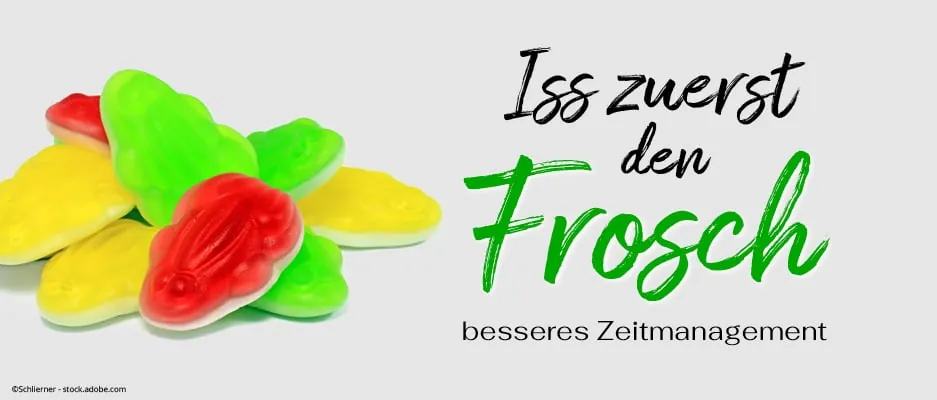
How the Eat the Frog method can help you manage your time better
You know that frogs are considered a delicacy in some countries, but you can’t see any connection to your working day and especially to your own time management? You would like to learn a small secret of success that fits perfectly into your daily routines?
Then the following lines are not just a welcome explanation but practically required reading!
Eat the Frog – what is it about?
Before we start explaining the term, we have to bring in another one: procrastination. Who doesn’t know it, the “putting-it-off” disease, where you keep pushing all the unpleasant tasks ahead of you and can’t get going? You like to tell your conscience that tomorrow is another day, and conveniently ignore the fact that other tasks and duties are waiting the next day. As a result, you don’t get round to doing the uncomfortable things the day after either.
Does this dilemma sound familiar? Then the Eat the Frog method will be very helpful to you, because it is both simple and effective. It was invented in America by an author and success coach named Brian Tracy, who wrote an entire book on the subject. In America, a saying goes that whoever eats the biggest frog in the morning has the most unpleasant task behind them.
In the eyes of most people, frogs are not very appetising but slimy and slippery. They are also hard to catch because of their small size and their ability to jump – a symbol, then, for all the uncomfortable tasks that you so like to push to the back of your mind and put off.
The Eat the Frog principle says that, of all the things waiting to be done, you tackle the most unpleasant task first and prioritise the order of work.
When you put things off, time usually runs away from you; with Eat the Frog, on the other hand, you gain time, because you use it sensibly and it is not stolen from you in the future by unfinished to-dos.
Instead of building up time pressure, you create mental space and can tick things off. This brings quick feelings of success and creates new motivation. So everyone should try out what it is like to eat the biggest frog first.
How to apply the method
In principle, Eat the Frog is like (to stay in the animal kingdom) your inner couch potato – it has to be overcome before anything can happen.
So the first thing is to find out which is your biggest frog. Instead of thinking up excuses, take a moment to consider which of the tasks waiting for you you least like doing. It does not matter why they annoy you. Big frogs are, for example, things like writing your tax return, clearing out the file store, introducing new software etc. What matters is that you tackle the most unpleasant task first! So it is about analysing and then taking action with your own time management in mind. Your time is valuable and will certainly be needed elsewhere too, so it makes sense to clear the biggest obstacle out of the way straight away. Of course, this takes time as well, but you get something very valuable back from your investment of time: you give yourself a sense of achievement, feel relieved and gain new motivation.
A-B-C-D-E tasks
Brian Tracy even goes one step further by dividing tasks into A-B-C-D-E tasks.
A tasks are the second-biggest frogs, which are absolutely important and urgent. If they are not done, there will be negative consequences.
B tasks are also important, but rank after the A tasks (e.g. publishing a new job advert after an employee has been dismissed).
C tasks can be done after the A and B tasks. It does not matter if you don’t tackle them for now.
You shouldn’t take care of the D tasks personally anyway, because they can be delegated and should take up other employees’ time.
E tasks are unimportant things that are not relevant to you and should be struck from your time management.
Advantages and pitfalls
If you have never looked into the Eat the Frog method before, you may find it hard to get started at first. After all, there is a reason why you keep putting off the unpleasant tasks. Still, practice makes perfect!
Once you have made a start, you will soon get used to your changed routines. Feel free to buy a plastic frog and put it on your desk as a reminder of the new principle.
Every time you tackle an uncomfortable topic, you are also training your willpower, which generally benefits your professional success.
Get an overview
It also helps to pick up pen and paper to define the frogs and set the time frame within which they have to be eaten. The digital alternative is “to-do” software, which you can use to plan and keep track of your activities.
Breaks help you to recharge and briefly distance yourself from unpleasant activities. You will need them now and then, because nobody can eat frogs all day long. The nice thing is that you feel better already during your breaks and in the evening after your working days, because you know that you have achieved something and are making progress with your plans. The bad thing about putting things off is that a guilty conscience is always there in the back of your mind and really spoils your day, because you start out demotivated in the morning and feel bad all the time.
Instead, you have new energy and your time management better under control. The unpleasant topics no longer block you, and you have more time left for what really matters.
Better teamwork with the Eat the Frog method
At some point you will be really good at applying the Eat the Frog method and can teach it to others. Together you are always stronger, and if you use the method as a team, a whole new dynamic will develop from it (motivating each other, more fun working through tasks etc.).
What’s stopping you from starting a frog-of-the-month contest? Rewards are also an important factor in Eat the Frog – reward yourself and your colleagues when you have managed something that has been weighing on you all along. 🙂