Types of conflict and the art of conflict management
What types of conflict occur in your company and how can you resolve them with smart conflict management?
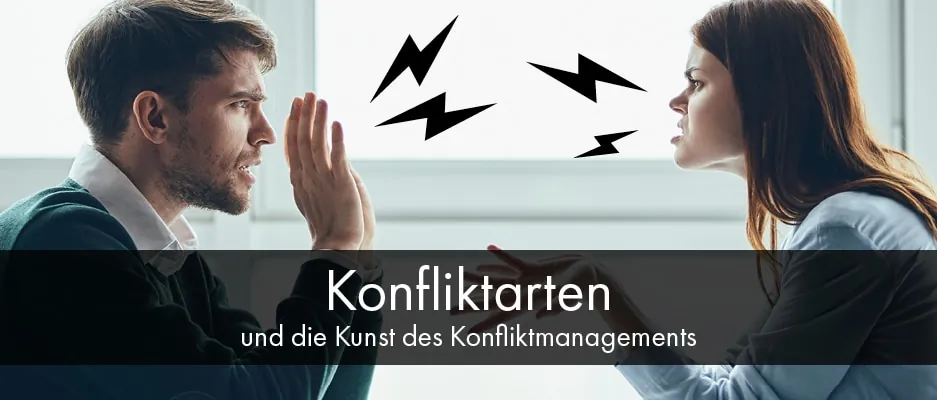
Konflikt (conflict), noun, masculine.
“Difficult situation arising from the clash of conflicting views, interests or the like, which can lead to a rift.”
So much for the definition of “Konflikt” (conflict) in the Duden dictionary. In everyday life – in private as well as professional situations – the term is filled with life. Here you will find out what types of conflict there are, how they arise and how best to deal with them.
Which types of conflict often occur in everyday working life?
The interesting thing about conflicts is that there does not necessarily have to be a real problem. It is enough if just one of the parties involved believes that a problem COULD possibly exist. And this already shows: to avoid conflicts, transparency and communication are two factors that can be extremely effective in preventing them.
By the way: the more clearly defined individual processes are in a company, the less confusion there is about certain procedures. An example: the production department introduces a new process to shorten the manufacturing time for product X. Quality assurance, however, now finds that although product X is now produced faster, the error rate has increased. So what should be done? Well, first of all it will certainly help to sit down together at one table to hear the individual opinions. In addition, a data analysis must be carried out to reveal the effects of the new production process on the production figures and the quality of product X. An external expert opinion and the associated exchange of experience may help. Then it is time to find a solution: is there a compromise? How long does a possible pilot phase need to last to implement the new process step by step and thus ensure quality assurance? How often do there need to be feedback loops? Transparency, structure and communication – anyone who observes these three pillars of conflict management is on a productive path when it comes to resolving conflicts.
Factual conflict
Factual conflicts such as the example above of the conflict between production and quality assurance arise when individuals or groups have different views or opinions about a specific matter or task. These are often the simplest conflicts, because the solutions are based on objective information and logical argument.
Relationship conflict
Relationship conflicts occur when personal differences, misunderstandings or antipathies are involved. They can arise from communication problems, different values or personal dislikes. Approaches to a solution include open communication, empathy and sometimes mediation by a third party to bridge the personal differences. Relationship conflicts are often accompanied by unobjective criticism – you can find more information on this in our article “Dealing with criticism”.
Role conflict
This type of conflict arises when the expectations of a role are not clear or when a person is confronted with contradictory expectations. This can happen, for example, when an employee is unsure which priorities to set. Coping strategies include clarifying role expectations and seeking a consensus on roles and responsibilities.
Distribution conflict
Distribution conflicts arise from the perception of unfairness in the distribution of resources, recognition or responsibilities. A team member feels that they are doing more work than others without receiving the corresponding recognition? Dealing with this type of conflict requires transparency in decision-making and fair distribution mechanisms.
Evaluation and perception conflict
These types of conflict occur when situations or information are interpreted differently because of the unique perspectives involved. To resolve these conflicts, it is important to explore the perspectives of everyone involved and to reach a common understanding.
Conflict of goals
Conflicts of goals arise when goals or aspirations are incompatible with each other. Company XY has to choose between maximising profit and sustainability? Identifying common goals and looking for compromises are essential steps towards resolving such conflicts.
Are conflicts always negative?
Conflicts do not necessarily have to be negative. In fact, functional disputes on a factual level are essential for the growth and development of organisations. The challenge is to enable such functional conflicts and, where appropriate, to encourage them without letting them slide into dysfunctional, destructive types of conflict. The art lies in keeping conflicts away from the personal level to prevent them from destroying the team dynamic.
The good news: the conflict competence of team members can be strengthened. This means learning strategies to carry out conflicts in a way that enables factual improvements without damaging interpersonal relationships. Key communication skills play a central role here:
- Listening
- Giving feedback
- Receiving feedback and taking it seriously
- the ability to address and negotiate different interests
Improve your communication with infra-struktur
With infra-struktur, you and your team have all parts of your communication in one system
Conflicts on a factual level are one thing – relationship conflicts, on the other hand, are quite another. These require a solution on a personal level:
- The first step is to create an environment in which everyone involved feels heard and understood. This requires each party to listen actively and try to understand the other’s perspective without immediately judging or criticising.
- Relationship conflicts are often deeply emotional. It is important to acknowledge the feelings of everyone involved and to communicate them as well. This helps to reduce tension and shows that the concerns and needs of the parties are taken seriously.
- Direct and open communication is crucial to avoid misunderstandings and to address the actual causes of the conflict. “I” statements should be used to avoid accusations and to make your own perspective clear.
- The parties to a conflict often have more in common than they think. Identifying and focusing on common goals or values can help to strengthen the relationship and pave the way to resolving the conflict.
- In many cases, resolving relationship conflicts requires compromise. Both sides should be prepared to make concessions and be flexible in their positions in order to find a solution acceptable to both.
- Once an agreement has been reached, concrete steps and arrangements should be set out to implement the solution. Both sides must keep to the agreements made and regularly check whether the solution is working as intended.
- After the conflict has been resolved, it is important to work on the relationship and encourage positive interactions. Regular communication, mutual appreciation and celebrating successes can help to strengthen the relationship in the long term and avoid future conflicts.