Pinocchio syndrome: dealing with liars at work
When lies become a problem – how to recognise Pinocchio syndrome and how to deal with liars at work
A little fib here, a white lie there, a bit of cheating on the tax return – where does fudging actually end and lying begin? Sometimes it is simply easier to lie. If the answers to the question “So, how are you?” were regularly honest, you would certainly often need more time than for the usual short “Fine, and you?” The problem with lies, however, is that, as the saying goes, they don’t get you far. They usually only work (if at all) in the very short term. Yet fibbing and lying are so widespread that the phenomenon has even been given its own name.
What is Pinocchio syndrome?
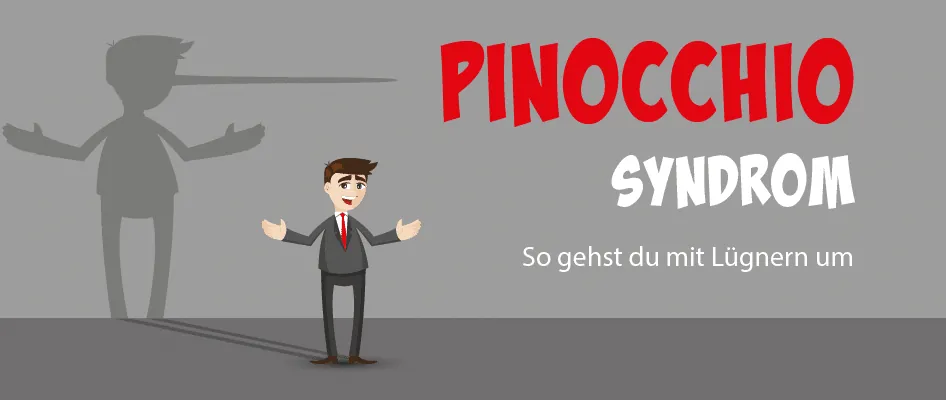
Pinocchio syndrome describes a phenomenon in which people tend towards a pattern of repeated and often unnecessary lying. The tendency to twist or hide the truth can stem from a variety of psychological, social and emotional reasons. Although it is not a recognised diagnosis in the medical sense, the term sheds light on a behaviour that can become problematic in certain cases and have serious consequences.
The reasons for this behaviour are varied and complex. They range from low self-esteem and the wish to appear in a better light to deeper-seated mental disorders. In some cases, lying can also be an escape from reality, a way of coping with stress, anxiety or other distressing emotions. Whatever the causes, continued lying can lead to relationship problems, loss of trust, professional difficulties and a damaged self-image.
Lying in everyday working life: a case study
Julia, a reliable employee at a small marketing company, misses an important deadline. She was actually supposed to draw up an important project plan in detail, but now she hastily puts together a few unchecked figures to avoid trouble and consequences.
Based on the project plan, the team starts calculating the costs and runs into unexpected challenges. The estimates are unrealistic, and it quickly becomes clear that the budget for the planned project will not be enough. More and more inconsistencies are found, and it turns out that the project plan doesn’t work like this. But a large order has already been placed on the basis of Julia’s calculation.
Julia’s guilty conscience has been keeping her awake for days. She knows she has made a mistake, but dares less and less to admit it. Yet she realises that it will end in disaster if she sticks to her lie. However, the decision to raise the matter is taken out of her hands. Her manager has meanwhile analysed the project plan and knows that Julia made up the figures. She asks Julia for a meeting in which all the facts are laid on the table and Julia admits her lie.
Instead of a punishment, however, Julia is met with an unexpected reaction: the manager offers her support to find a solution together. They both realise that openness and honesty are the key to avoiding future mistakes.
The team works together to save the situation, learning the value of transparency and teamwork along the way. Julia is grateful for the second chance and tries to make amends through greater commitment.
infra-struktur for better collaboration
infra-struktur creates more transparency and traceability for the whole team.
How can you recognise lies?
Recognising whether someone is lying can be a challenge. But there are certain signs that can point to untruths. Inconsistencies in stories, for example, are a common feature. Liars often find it difficult to keep their story the same when they tell it repeatedly. Avoiding eye contact can also be a sign, as can a flood of excessive detail in an explanation that is meant to make the story seem more credible. Body language can often be revealing too. Restless behaviour such as nervous fidgeting or avoiding eye contact can, in combination with inconsistencies, be an indicator of lying. In many cases this goes hand in hand with a change in the pitch of the voice. A higher-pitched voice or frequent throat-clearing can indicate nervousness.
Caution: taken on their own, none of these signs necessarily indicates a lie. However, when confronted with related inconsistencies in business processes, inexperienced liars in particular may show such behaviour.
Dealing with liars in the company
Julia’s example leads to a question that managers in modern companies have to address: how do I deal with knowing that I am being lied to at work?
– First, as a preventive measure, work towards a general atmosphere in which employees feel safe to voice mistakes and concerns without fear of negative consequences. This reduces the need to resort to lying.
– If you suspect someone is lying, address it with the person directly in a non-confrontational way. Use “I” statements to express your observations without putting the other person on the defensive.
– Make it clear that honesty is highly valued in the company and that deception will not be tolerated. Define clear consequences for dishonest behaviour.
– Sometimes lies are rooted in deeper problems. Offer support and resources to help the people concerned deal with their challenges.

Pinocchio vs. Münchhausen
Unlike Pinocchio syndrome, which is not an illness, there is a mental disorder called Münchhausen syndrome. Baron von Münchhausen is a historical figure from the 18th century, known for his rambling and fantastic tall tales. Münchhausen syndrome combines invented physical complaints with made-up stories about how they arose. The aim is to gain attention. Münchhausen syndrome is a special form of “pathological lying”. This mental disorder is listed in the ICD-10 (International Classification of Diseases) under “other disorders of adult personality and behaviour / factitious disorder”.