Relying on asynchronous communication when working from home
When working from home, synchronous communication rules! Meetings, calls, check-ins & the day is over. The solution is asynchronous communication

Do asynchronous arrangements make you more productive?
There are a number of differences between machines and people. A very important one lies in human creative productivity, and that is encouraged when we are not constantly distracted “synchronously”. No robot and no “artificial intelligence” can keep up with that. People are still the guarantee of success. As an entrepreneur, my interest therefore lies in making the most of this productivity and in this way unlocking the potential of the team. It helps if work can be done not only synchronously but also asynchronously, that is, if “sources of disruption” are avoided.
Synchronous communication when working from home
Employees will never reach their full potential or bring all their skills to bear if they are kept on a “short leash”. Studies show that creativity in particular needs freedom. Thought processes, research, trials and so on all need time and space, and often the “right moment” as well.
However predictable and well organised things are, success does not follow a fixed law. Especially in an economy that keeps increasing the pace and craves innovation and progress worldwide, we rely more and more on direct arrangements and being available at short notice. Our communication is increasingly mainly synchronous; with the smartphone always beside us, we are almost constantly available, whether as managers or employees. The increase in workplaces at home in particular has favoured synchronous communication even more, as video conferences have increased massively on top of arrangements by phone.
Some businesses seem to have discovered video calls for themselves: on the one hand, they allow management a “quick check that everything is in order”. We humans find it easier to form an impression when we can see things “with our own eyes”. On the other hand, more meetings than before are possible, simply because there is no travelling and so on. Participants are quickly called together for a conference, even if it is “just for a moment”.
Is synchronous communication really the best option?
In principle yes, especially when it comes to fast decision-making. But as so often, there is a downside here too. A purely synchronous approach to communication leaves little room for creative freedom and productive working time, as the day is mainly shaped by exchanges and scheduled meetings. When someone calls, immediate availability is expected, which means that current tasks have to be interrupted. This can considerably impair the efficiency of processes and block potential for development. Nevertheless, “real-time communication” in the form of conversations, phone calls and video conferences keeps increasing, and many workers spend most of their time on synchronous arrangements.
Encouraging asynchronous communication
Asynchronous communication is meant to achieve exactly the opposite by trying to keep synchronous arrangements to a minimum. Supporters cite in particular the argument of deep work and shallow work, that is, the distinction between in-depth work (deep work) and superficial activity (shallow work). Synchronous communication favours superficial activities, the argument goes, while an asynchronous approach encourages in-depth work. Conversely, the latter in particular could significantly increase your own productivity.
A very simple example: instead of regular personal reports in meetings on the current state of affairs, it makes sense to record interim results and outcomes continuously in a central place. This gives each individual much more flexibility. Nobody then has the time pressure breathing down their neck of having to finish a presentation and so on by the scheduled meeting. At the same time, everyone involved, working from home too, has access to all information in a central place at any time. Here too, nobody needs to wait for a personal conversation to make progress in their own work. This is where XRM systems shed light on things. An additional, very positive effect: the work of individuals or a team becomes much more transparent, everyone is up to date – even without “never-ending meetings”.
Asynchronous does not mean that communication stops
Asynchronous communication is not achieved with a few restrictions on correspondence and a reduction in direct communication. There is more to it than that. For a company, it is a complete change of perspective, which as a rule does not happen overnight. Because a non-synchronous way of working does not mean that communication stops. It just works completely differently from before. The documentation mentioned earlier – e.g. traceable contact, customer or project histories – plays an absolutely essential role here. If it is used properly, many questions can already be answered from the chronological documentation without the need for constant synchronous exchange.
All well and good, but everyone knows that good documentation does not fall from the sky. Everyone involved has to stick to it consistently so that no untraceable gaps arise. XRM systems help here too, because large parts of the communication and documentation automatically end up where they belong, e.g. with e-mails and telephony.
The best solution: a good balance between synchronous and asynchronous arrangements
An asynchronous company culture does not do away with direct exchange entirely either. Experts recommend a daily half-hour exchange at a fixed time. Admittedly, this would correspond to an entirely synchronous meeting. At the same time, though, all other previous interruptions in the form of continuous direct “status updates” disappear, so that you can once again focus your working capacity fully on the project. The advantages are clear: asynchronous communication can be a key to increasing productivity.
However, direct arrangements cannot be stopped completely. In some cases that would be counterproductive, for example if we think of the staff of a customer hotline. Especially for emergencies and urgent matters, the option of a synchronous response must always be available. So it comes down to a good sense of proportion. Where asynchronous communication can be implemented, companies should make effective use of this option.
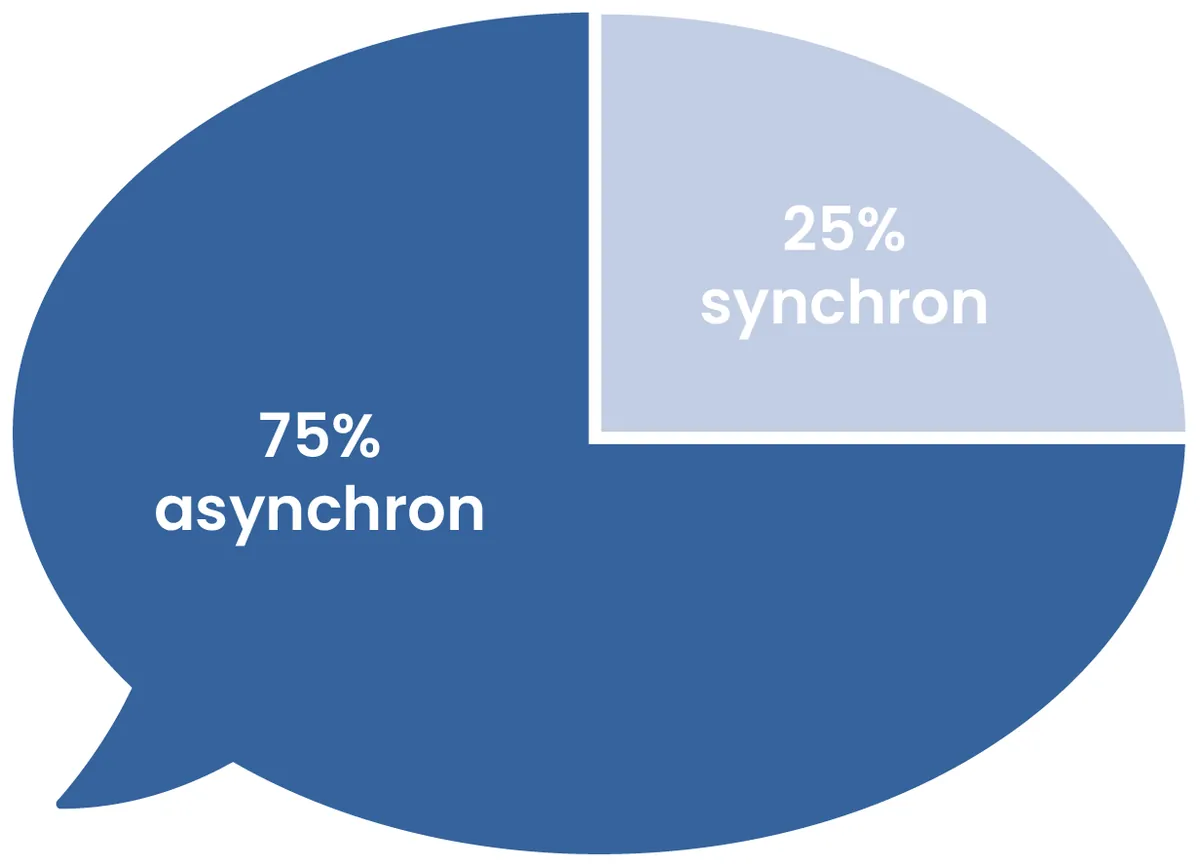
Successful examples assume a rough split in which 75% of communication is asynchronous and the remaining 25% synchronous. The current times are strongly encouraging workplaces at home, so now is the ideal moment to introduce an asynchronous company culture. Nobody needs to turn their existing procedures completely upside down; small steps also go in the right direction.
However, if a company wants to improve its workflow for the long term, it should definitely question its existing channels and forms of communication and rely more on an asynchronous approach in future.
Synchronous & asynchronous – it’s all in the mix!
For more than 25 years, we have been helping companies keep track of everything with our XRM system.