Overload and stress despite time management
Do time management methods lead to less stress? If the time you gain is filled with more tasks, you quickly become overwhelmed and overloaded.

Overload and stress despite time management – how to solve the problem

In the search for the ultimate solution for all those who feel crushed by their tasks, you come across various time management concepts. But reality shows that this alone is not always enough.
Working efficiently and delegating can help you gain more freedom, but often this simply means that even more responsibility is loaded onto your shoulders – creating an endless spiral of stress and overload.
Fortunately, besides classic time management, there are many methods that can help you cope successfully with the flood of tasks. In this article, we would like to present some of the most effective approaches.
As already mentioned, time management frees up time for you, which you then normally let your colleagues fill up again straight away with new tasks. The result is a stress spiral. This has to stop – and only you can make that happen! Practise saying “No”. In a moment, we will explain the difference between important and urgent tasks – that should give you a feel for which tasks you should take on as a manager and which you should not.
The three most important tasks
One of the really important methods for getting the most important things done every day. When you plan your day, think very carefully about which 3 tasks are the most important, so that you are not overwhelmed straight away. Be clear about this: if you manage only these three things, your work that day was a complete success. The reality is that we do not manage many more than three significant tasks a day – no matter how much we pack into our daily plan. If there are other tasks that urgently need doing, think about how best to delegate them when you plan.
Planning and organising tasks?
Child’s play with infra-struktur
The difference between
To get a better feel for prioritising, you should definitely be clear about the difference between important and urgent activities. Important tasks are those that move you as a person and/or your business forward. Urgent activities have to be done quickly and are characterised by putting a lot of pressure on you. Because urgent tasks bring an enormous amount of pressure with them, they often seem to be important too. But often they are not at all – which is why you can simply delegate them and let others do them. As a managing director or senior employee, you should always focus on what makes your department or your business grow – and those are the important tasks. If you take only this to heart, your time management will already give you considerably more freedom.
If you would like to dive even deeper into the topic, we recommend looking into the Eisenhower principle.
Avoiding overload caused by distractions
The phone rings, an e-mail comes in and some unimportant social network shows 3 unread notifications – our modern everyday life creates a flood of information that often overwhelms and needlessly distracts even the best-organised project manager. Be clear about which influences or messages really matter to you right now and which you can switch off without any problem. Make a fixed plan for how often you check your e-mails or how often you scan the task list on the home page of your infra-struktur. You will find that reducing these distractions does not make anything slip through your fingers. Quite the opposite: you are no longer so overwhelmed and can focus much more strongly on the tasks that really matter.
Handing over decision-making power
As a manager, you surely know this: you are sitting at your office desk, your pulse is already at 180 because of numerous challenges and a huge amount of work. And your employees have nothing better to do than bring even more work into your office every hour – even if it is only small decisions they want you to make for them. You can imagine it as if they were carrying stones into your office with every new request. You can sort and rearrange them – but at some point the room is full and you cannot move an inch.
One of the most effective methods against this is to hand over more decision-making power to employees and colleagues. Give them clear guidelines and then let them make increasingly bigger decisions on their own. If you work in purchasing, for example, give a newcomer authority over purchases of up to €300, and let a team leader make decisions up to €5,000. These are of course rough figures that should be adapted to your industry and your purchasing volume. But you will see how many fewer decisions you have to make after this step. And the quality of the decisions will also rise – after all, an employee can get into their own small area much better than you can. One last positive side effect: your employees will quickly enjoy thinking for themselves again and will feel more important – which has a positive effect on overall morale.
Change takes time – let go of stress with the 21/90 rule
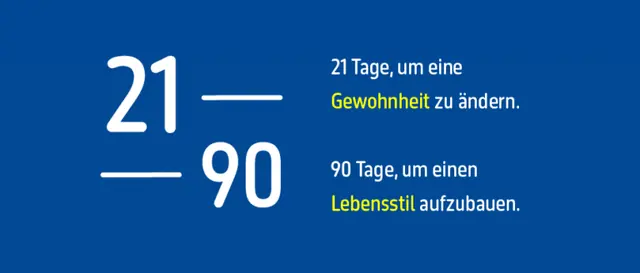
You cannot get rid of overload overnight with the methods presented here. After all, your stress probably did not build up in the short time it took you to read this article either. To assess a change, you should follow the 21/90 rule. It says that you need 21 days to turn a new action into a habit. After that, you need another 90 days for you to do it automatically – only then has the action become routine. During this time, keep reminding yourself of the goals you want to achieve through your new way of handling time.