The Benjamin Franklin effect: how enemies become friends
The Benjamin Franklin effect: through liking & affection you turn your enemy into a friend & colleague. Small favours, big impact.
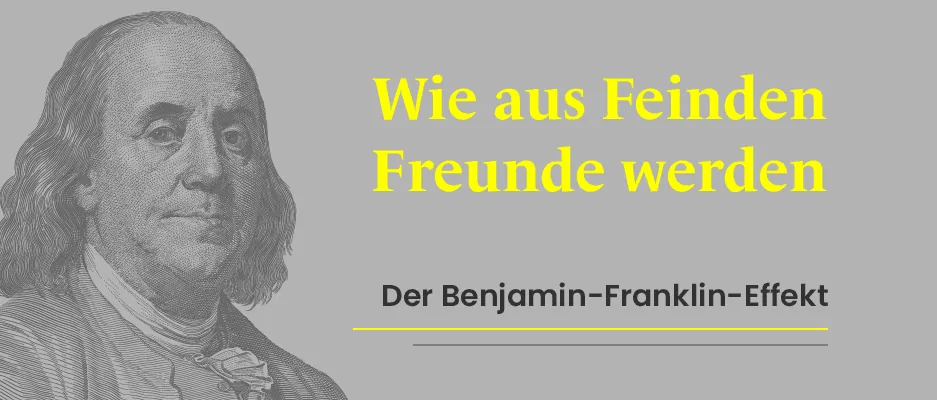
Deep down, it matters to all of us that other people like us. Being likeable wins you not only friendships but also new business relationships that lead you to greater success. But how can you actively help to come across as likeable and win the other person over? The Benjamin Franklin effect can help you here.
According to tradition, Benjamin Franklin, one of the Founding Fathers of the United States, had an enemy who, in his view, was influential and whom he wanted to win over. As this enemy was a well-read man who was known to own many clever books, Benjamin Franklin asked him whether he would lend him a book. The good man agreed to this favour and went from enemy to long-standing friend. But how is that possible?
The Benjamin Franklin effect: two explanations shed light on the matter
By asking his enemy for a favour, Franklin flattered him. With his request, Benjamin Franklin expressed that he was interested in the man’s books and therefore considered him clever. He also made it clear that he would like to read one of the books himself. That is flattering!
The former enemy will then have experienced an unconscious emotional turmoil. He will have thought that Franklin cannot be so unlikeable after all. After all, he appreciates his books and therefore also his intellect and him as a person. Apparently Franklin thought very highly of him and showed him a certain liking and perhaps even affection. Otherwise he would not have asked him for a book. This emotional turmoil is also called cognitive dissonance.
The Benjamin Franklin effect and the principle of cognitive dissonance
Cognitive dissonance means that our brain perceives a contradiction. Imagine a colleague you didn’t particularly like asks you for something. For example, he praises you for bringing the tastiest cake into the office and asks whether you could write down the recipe for him.
How do you feel now? You will probably feel flattered. You notice something you have in common with this colleague – you have the same taste. You will also feel just a tiny bit important because your baking skills are being praised.
Your brain is now confronted with a contradiction: this colleague can’t be that unlikeable if you have the same taste! If he thinks you are so competent when it comes to cake, he must feel a certain liking for you, right? So isn’t this colleague actually quite likeable after all?
Little by little, you will now discover more and more likeable sides to this colleague. Your brain has resolved the cognitive dissonance: you have helped a friendly person who has the same taste as you. So everything is back in balance.
But as we will see in a moment, another phenomenon is at work here – reciprocal liking.
Reciprocal liking and similarity
You probably feel that this colleague likes you if he asks you for the recipe for your cake. Who would ask a favour of someone they find completely unlikeable? And who wants to cook the same dishes as their arch-enemy? So you can assume that this colleague likes you. This assumption in turn creates reciprocal liking. This means that we usually like people who like us. After all, they must be nice people if they recognise our qualities! In addition, this person has similar taste to ours, so they are like us and therefore we must like them.
Making friends with the Benjamin Franklin effect
The Benjamin Franklin effect does not only work when you want to turn enemies into friends. The Benjamin Franklin effect can also help if you want to win the liking of the people around you, in business or in private. So don’t be afraid to ask others for a small favour or for advice.

Beware of overdoing the Benjamin Franklin effect
But you should never overdo it. So make sure you don’t ask for things too often. Here – as so often – the dose makes the poison!
In addition, it really should be a small favour that does not demand too much of the other person. So make sure that your request does not require a great deal of trust or cost the other person a lot of money, time or effort. In a business context in particular, you should also take care to keep the necessary distance and not intrude too much into private matters. The other person must not feel cornered. They should feel flattered and important!
Choosing the right situation also takes some tact. It is often better to ask for a favour in private. Think back to the example with the cake. Otherwise, some other colleagues who have also brought in cake could feel belittled. You would then have won the affection and liking of the person you praised, but at the same time you might have made enemies of other colleagues.
Empathy – the miracle weapon
Empathy, i.e. being able to put yourself in someone else’s shoes, also plays a role in the Benjamin Franklin effect. Both the person asking for something and the person granting the request need empathy. The person asking has to develop empathy for the person they are asking for advice or a favour. How will the other person feel when I make this request? Will it cause a lot of trouble?
But the person you ask for something also has to put themselves in your shoes. Perhaps they never really thought about you before, let alone had any understanding for you? That will most likely change now.
Did you know that you can’t truly dislike someone from the bottom of your heart once you put yourself in their shoes? Once you know all the challenges, burdens, fears and insecurities of the other person, you almost automatically develop understanding for them. As soon as you know about their family, work, health and financial problems, a certain liking develops.
Conclusion on the Benjamin Franklin effect
Of course, you can use the Benjamin Franklin effect in a very targeted and planned way, which is also done in business and in sales conversations. The more important insight in connection with the Benjamin Franklin effect, however, is that you don’t need to be shy about asking others for advice or small favours. Because now you know that this is understood as an expression of liking and appreciation.
So go ahead:
Ask for all those tasty recipes, tips and tricks, borrow all those exciting books – and make new friends along the way.