Ethos, pathos, logos – the rhetorical triangle
The rhetorical triangle – ethos, pathos, logos – helps you persuade with the power of rhetoric in speeches and presentations.
To write credible texts that convince your customers, it is important to know and apply the rhetorical triangle – ethos, pathos, logos. Knowing how language works makes the difference between good texts and truly gripping ones.
The rhetorical triangle
The rhetorical triangle was first described by Aristotle in his Rhetoric. In it, Aristotle points out that rhetoric is the art of persuading rather than talking someone round. Persuasiveness is not an innate ability; anyone can learn it. To do so, you need to know the three means of persuasion:
Ethos
This component is credibility. Ethos describes conveying self-confidence and knowledge. Customers will not buy a product you know little about. But an authentic and trustworthy manner is also essential. Readers or listeners want to feel that you take them seriously.
To give you a little help, here are some points on content to put the first pillar, ethos, into practice as well as possible.
Who are you?
Talk about your experience and qualifications here. The odd bit of personal background can make you seem more human, which helps your readers and listeners identify with you.
Do you know your target group’s problems?
Only then can you convince them that you are exactly the right one for them, or even that you have the solution they are looking for.
What do you stand for?
It is important that you first know for yourself what your strengths and your message to your customers are. Make sure you only highlight what sets you apart from the crowd. Pick no more than three points. Too many strengths and promises make people suspicious.
Are your business model and product transparent to outsiders?
Can the reader or listener find relevant information straight away? Hidden prices in particular often make people wary. If you mention sales incentives such as environmental protection or support for clubs, show results too.
Are you reliable?
Let references and customer opinions speak for you here. Ask customers for a short review of your work. It is important not to rely on bought reviews, because sooner or later this will be noticed and will do lasting damage to your credibility.
With ethos, it is important to largely do without empty phrases and filler words. Both signal that you are stalling and convey uncertainty. Every sentence must contain information for your readers and listeners.
Credibility begins with good communication
If you want to convince customers, you should know what has already been discussed, agreed or promised. With infra-struktur you bring customer information, e-mails, tasks and other processes together centrally in one place. That way your team can see at any time what’s going on.
Pathos
In rhetoric, pathos picks up on the emotions of the audience and draws them into what is happening. Engaging intensively with your target group is crucial. Picture your model customer and think about what they look like and what their interests, preferences and fears are. Readers and listeners will sense when you know them. Browse forums and make small talk with customers. Here too there are a few tips for mastering pathos.
Tell a story
Use a scenario, a story, perhaps as an introduction. Pay attention to the dramatic arc. This short story must make the audience feel with it. If storytelling is not your strength, ghostwriters can help you.
Use images
If you underline your text or talk with images, you engage even more senses and draw readers and listeners deeper into what is happening.
Use metaphors
Metaphors are a good way to liven up your presentation, and they create images. The human mind works with images, not facts, so a visualisation, even in verbal form, can be more memorable than dry text. Metaphors are not to be taken literally. Dreams blossoming and growing call to mind a plant that grows and thrives. Or perhaps you would rather persuade people to stop hiding behind a logo, or to climb the career ladder without falling victim to a pyramid scheme? So they don’t have to be creative new inventions. Feel free to use tried-and-tested phrases. The metaphors you choose should trigger an image instinctively, without your audience having to think long about the meaning. That works best with familiar ones.
Visualisation tips
For visualisation, presentation slides, website texts and the like should preferably be supported with images. Use keywords instead of sentences. This also helps you speak more freely and authentically.
Strong verbs for strong texts
Use strong verbs. These are verbs that work without auxiliary verbs (have, be, will). That sounds more complicated than it is. It not only makes a text livelier but also puts it on a diet, which makes it easier to understand.
An example sentence illustrates the principle. The company has innovative solutions to offer.
This sounds much punchier: The company offers innovative solutions.
Targeted adjectives hit the mark
Use adjectives in a targeted way. They describe qualities. Don’t pave your talk with too many adjectives, because then they quickly lose their effect. Doing without them entirely makes a text or speech wooden.
Here is an example too: Through the innovative approaches of our trained and experienced specialist staff, we ensure a smooth and successful start for your company.
That is too long and the adjectives fade. So this would be better: Through the innovative approaches of our experienced specialist staff, we ensure a successful start for your company.
Brevity is the soul of wit
In rhetoric, keep sentences and explanations short and to the point. This applies to every pillar of the rhetorical triangle. That way listeners and readers can follow much more easily. An editor can help you optimise your text and can be a worthwhile investment, especially for website texts.
Personal communication needs the right context
Customers don’t want to feel like just a number. With infra-struktur, your team has important information and previous communication right in view – for conversations that are more personal and better prepared.
Logos
The third side of the rhetorical triangle covers arguments. This is how you reach rational people. Instead of credible and emotional words, it is now about figures, data, facts and evidence. Everything that is measurable falls under logos.
There are two ways you can approach this.
Inductive logic
The first is inductive logic. Here you reason from various facts to a general course of action. For example, four statistics show that digitalisation increases work output in quantitative terms. From this you conclude that digitalisation makes sense.
Deductive logic
The second kind is deductive logic. This is about reasoning from general courses of action to facts, in other words exactly the other way round from inductive logic. For example, many people use digitalisation, and from this you conclude that it improves work output. Otherwise so many people would not use it.
Which logic is best depends on your service or product. If there are many facts, inductive logic makes sense. Sometimes, however, there are no figures. In that case, deductive logic is the method of choice.
Here are a few tips on how you can bring logos into your texts and speeches.
Structured text
Logic already shows in a structure. Build up your text or speech in a structured way. Group related topics under one point. Proceed chronologically and step by step. Otherwise it comes across as unprofessional and your audience cannot follow you.
Be like Sherlock Holmes and provide evidence
Don’t just make claims, provide evidence. Your customers are very satisfied with you? What is your average rating? You do your work quickly? How long does it take on average?
Show it in a chart
As already mentioned under pathos, the mind works with images. So rather use charts, instead of just showing figures. Work with colours too. Refer to scientific sources. These could be, for example, statistics (such as the Statista and Destatis websites) or statements from specialist journals. Always state your sources.
With logos, it is important to convey information objectively. Emotions have no place here.
Good decisions need good information
Arguments are most convincing when the facts are right. infra-struktur brings important customer information, tasks, e-mails and other processes together. Instead of searching for information in different systems, you find it where you need it.
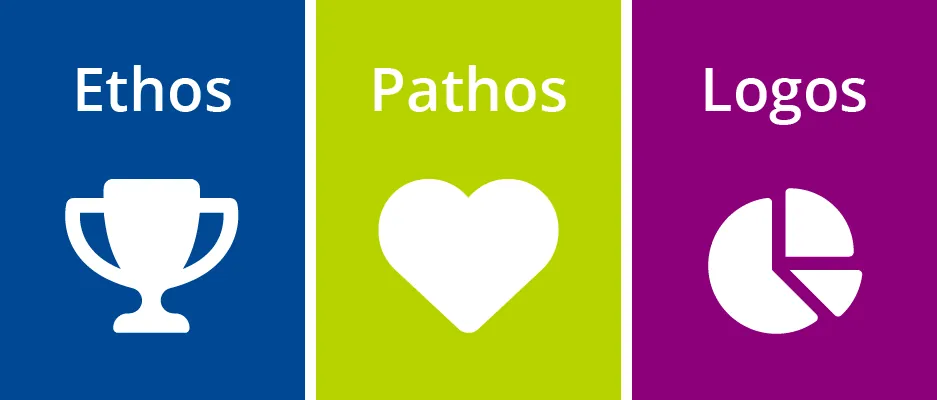
Ethos, pathos, logos – in a nutshell
Every good talk and text contains Aristotle’s rhetorical triangle, consisting of ethos, pathos and logos. Ethos covers credibility, pathos the emotions and logos the arguments. The three pillars can rarely be clearly separated and should be used in the right proportion, depending on the occasion and content.