Your personal working style and how it shapes your work
Find out how your working style influences your work – with examples and a description that helps you understand your approach better!
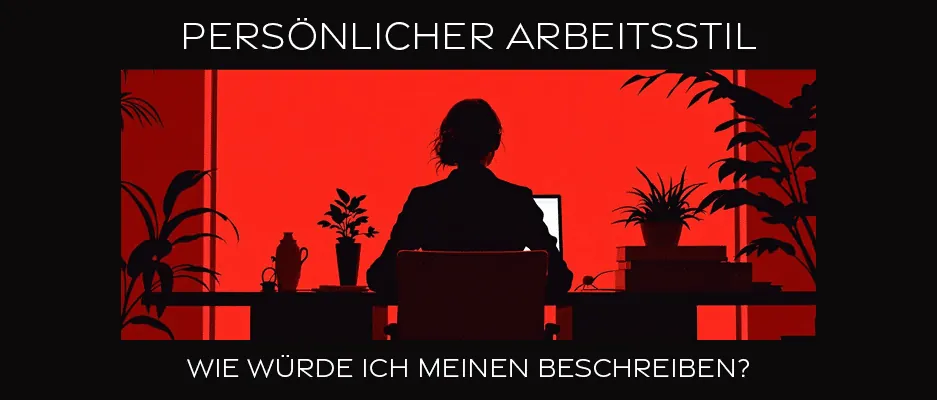
You may know this: the colleague at the desk to your left always works away calmly, his desk is tidy and everything is in the right place. Another colleague is always late and seems rushed, and his desk is chaos. Someone else in your department always manages to see the big picture and then breaks the individual tasks down into day-to-day work. Yet another colleague could spend hours on details. These are all examples of different working styles. Every person is an individual and has their own personal working style, which affects how they approach things. This article describes why it is important to know your own working style.
What is a working style?
Your personal working style is the way a person gets work and tasks done. A working style includes the methods and techniques you use to get things done, but also the way you communicate, how you structure your work and how you manage your time.
What characterises your personal working style?
Your own working style is shaped by your personality as well as by past experiences, by norms, values and culture. If you are asked to describe your working style, the following pairs of opposites can help you:
- Creative – analytical
- Organised – spontaneous
- Detail-oriented – keeping the big picture in view
- Communicative – quiet
- Team-oriented and cooperative – individual
- Flexible – consistent
- Experienced in routines – open to new things
- Pragmatic – planning ahead
- Fast – thorough and conscientious
- Independent – happy to work according to instructions
- Hands-on – waiting and analysing
Why is it so important to know your own working style?
Perhaps you have never thought about your working style and were then suddenly asked to describe it in a job interview. You may remember questions like these:
- How do you approach problems?
- How do you structure your day?
- How would you go about project XY?
- How would you describe your working style?
Were you able to give a good answer to these questions? And why are HR managers interested in a description of your working style? With this question, recruiters want to find out what makes you tick, how you approach problems and how you want to solve them. They want to know whether you bring the right skills to give the team the best possible support right now and to complement the existing employees ideally without causing friction. The requirements have to be assessed individually for each position, as the following example shows.
infra-struktur adapts to you
With infra-struktur you create a digital workplace tailored to you and your most important topics. Anything else would just be standard.
An example from practice: why your working style has to suit the vacant position
A fast-growing advertising agency is well positioned in creation and design because it has hired many creative minds in the past. This is important in order to meet the many customer requests. When it comes to a pitch, the team bubbles over with ideas, and it is often difficult to choose from the many creative suggestions.
What is missing, however, is a person who brings more structure to the creative and often disorganised working day. The agency is looking for someone who manages to prepare and present the ideas in a way that suits the customer. It needs someone who fits well into the team of creative minds but can work in a structured and analytical way and keeps an overview. The person should enjoy documentation and make sure that deadlines are met, which tends to suffer with all the creativity in the agency. Another creative mind would probably still fit well into the team and get on well with the existing team. In this case, however, a different quality is deliberately required. Despite their contrasting working style, the new team member must still fit well into the existing team. That is exactly the crux of forming diverse teams whose strengths complement each other well and who work together harmoniously.
Diverse teams with different working styles are more successful
Birds of a feather flock together. That applies in private life and in the world of work. Research shows that similar teams get on well because their values, norms and ways of working are similar. The members find it easy to understand each other, can judge what makes the other person tick and communicate well with each other. Today we know that diverse teams with different qualities achieve better results, because different perspectives are available to solve complex problems. If people tick in a similar way, they approach problems in a similar way, and fewer innovative solutions emerge.
But in diverse teams, friction is often greater because of the different characters, norms and values. A team member who thinks in a structured way may not cope well with the creative chaos of some colleagues. The creative person, in turn, feels disturbed in their work because they have to fill in yet another (in their eyes unnecessary) Excel document or stick to a complicated workflow that only keeps them from their actual work.
For HR managers, it is important to create a certain diversity. In the application process, they have to filter out candidates whose way of working would lead to problems or conflicts with the existing team.
Especially when filling positions in an international context, it is important to take intercultural particularities into account. Something that is completely normal in Germany may be frowned upon in Spain and unthinkable in China. While open communication, for example, is part of everyday working life here and is seen as an opportunity for personal growth, something like that is unimaginable in China because it means losing face.