Many new ideas in a short time with the 6-3-5 method
Sometimes you need lots of ideas in a short time – with the 6-3-5 method, you and your team can quickly come up with many ideas
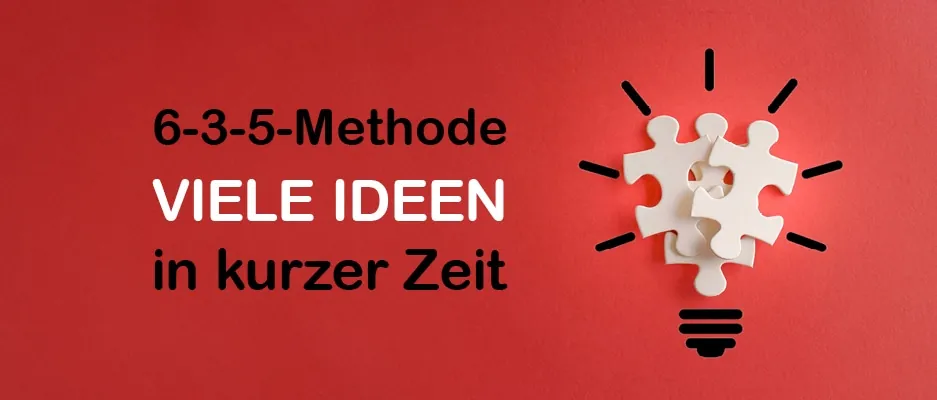
You surely know this too: new ideas are needed, you are sitting in front of a blank sheet of paper, but no flash of inspiration will come. Anyone who works creatively knows that new ideas do not come at the push of a button. But there are certain techniques that help you find new ideas: so-called creativity techniques. One of them is the 6-3-5 method. This article describes the principle behind it and how a handful of participants can come up with lots of new ideas out of nothing in half an hour.
The 6-3-5 method in detail
The 6-3-5 method or 6-3-5 principle was developed in 1968 by marketing consultant Bernd Rohrbach as part of innovation research. It is a brainwriting technique. The name of the technique says it all, because you need:
– 6 people
– 3 ideas
– 5 rounds
The numbers can also be interpreted a little more generously. The method is suitable for groups of three to six people. Depending on the number of participants and the complexity of the problem, the exercise can take between 20 and 60 minutes.
How the 6-3-5 method works
For the method you need paper, pens, a stopwatch and a whiteboard or pinboard. Then it is a matter of tackling a problem. The blank sheets are divided into three columns and six rows.
Step 1:
Once the problem is clear, each participant writes three ideas for a solution in the first row of their sheet. These three ideas should be as different as possible and address different aspects of the problem. Bullet points are enough; no full sentences are needed. It is important that no participant writes their name on the sheet. The method works better anonymously, because there is no premature judgement.
Step 2:
Now the sheets are passed on to the next participant. In the second column, they add their own ideas to their predecessor’s solution or expand on the idea.
Step 3:
The sheet is then passed on to the next participant, who adds their ideas in the third column.
When the sheet has returned to the person who wrote the first three ideas, the method is complete. The sheets are now pinned to the whiteboard and looked through by everyone involved. Depending on the type of problem, there is a follow-up workshop in which the ideas are worked out further. Or they are presented to a committee to decide on the next steps.
Rohrbach recommends 5 minutes per round. This is usually enough time to sketch out your idea roughly or to add to the ideas of others.
Ideally, this approach produces up to 108 ideas in half an hour, and at the end you are holding six sheets with 18 different suggestions. Of course, some ideas will be similar. But thanks to the different perspectives, there are many different approaches to tackling the problem.

Use cases for the 6-3-5 method
The 6-3-5 method is often used for problems that arise in a company for the first time. In consulting, for example, this might be the problem of a client from a new industry or the response to changing market conditions. It can also be about the company summer party or the response to a creative tender.
It is important that all participants have understood the problem, so that from the start the solutions address the right problem and head in the right direction.
A few important tips so that the principle works as well as possible
The principle is a brainstorming method. It is not primarily about the quality of the ideas, but about quantity. The participants should be encouraged to write down whatever comes to mind. These can even be unrealistic or absurd ideas. The ideas should not be evaluated while writing. After all, it can happen – and is even the aim of this method – that an idea that seems absurd at first later develops into exactly the right solution. That is the strength of this method.
It is important that the participants stick to the rules: one idea per column, no more and no less. If a participant has an additional idea, they can bring it up in the next round or in the final discussion.
Teamwork with infra-struktur
infra-struktur gives you and your team a workplace perfectly tailored to your needs – your digital desk for better teamwork.
The advantages of the method
The 6-3-5 method is simple and inexpensive to use. It needs hardly any preparation and only materials that every office has. Participants can work on generating ideas in parallel, and there is no idle time. Instead, many ideas emerge within a short time. During the 30 minutes, the ideas are not talked to death. This is a big advantage for people who may be afraid of other people’s feedback or who are generally introverted and do not like speaking in front of groups. When it comes to putting ideas on paper, nobody can push themselves to the fore and dominate the meeting. In the later evaluation, a moderator can help make sure every participant is heard.
The disadvantages of the 6-3-5 method
A good result is not guaranteed with this method. It can help you think creatively, but creativity simply does not come at the push of a button. For some participants, the rigid setting may hamper creativity. The set time may not be ideal for all participants. For quick thinkers, 5 minutes is far too long and they get restless. Other participants naturally need more time to put something on paper. This method can lead to redundancy, because all participants have the same ideas. There is no guarantee of many different ideas.