Stacey Matrix: a tool for successful project management
The Stacey Matrix supports you in project management by helping you find out which method is right for your project.
Project management is a complex matter. After all, you always have to keep an eye on the balance between time, cost and quality. As a project manager, it is your job to decide which tools and methods you use to achieve this. Fortunately, there are now many tools that can make everyday project work easier. Depending on the requirements, they support you in working in an agile or a traditional way. One of these tools is the Stacey Matrix. This article describes how exactly it can support your project management.
The history of the Stacey Matrix
The Stacey Matrix goes back to the South American Ralph Douglas Stacey. He taught as a professor of organisation and management at Hertfordshire Business School in the UK. He first published the original version of his matrix in his book “Complexity and Creativity in Organizations”. That was in 1996. Over time, other researchers developed the matrix further. Nevertheless, it has kept its original name in recognition of Ralph Douglas Stacey’s work. In practice today, however, a combination of the Stacey Matrix and the later Cynefin framework is mostly used.
The aim of the Stacey Matrix
The aim of the Stacey Matrix is, as a first step, to determine how complex a project is in organisational terms. Ideally, the project is assigned a specific degree of complexity.
The second step is then to define suitable tools and methods for the project management. This makes the matrix a tool for decision-making and for support in developing strategies.
The matrix also helps you decide whether you should work in an agile way or with proven methods.
How the Stacey Matrix works
The Stacey Matrix is built on a two-dimensional coordinate system. So there is an x-axis and a y-axis.
– The x-axis describes the (lack of) clarity about the solution approach or the next steps.
– The y-axis describes the (lack of) clarity about the requirements of the project.
The following questions help you find out more about the project requirements:
– Which goals does the project have to meet?
– Which requirements already exist for the project management?
– How clear is the task so far?
These questions help to evaluate the complexity of the project.
Once it is clear how complex the project is, the next step is to find the right methods to work on it. The following questions help with this:
– How can the project be carried out well?
– Which methods and technologies are ideal for supporting the project management?
– Is it better to work in an agile or a traditional way to reach the goals set?
Proven approaches can be used here just as well as new methods for which there is no experience yet.
The four different areas of the Stacey Matrix
Once you have filled in the Stacey Matrix, your project can be assigned to one of four areas:
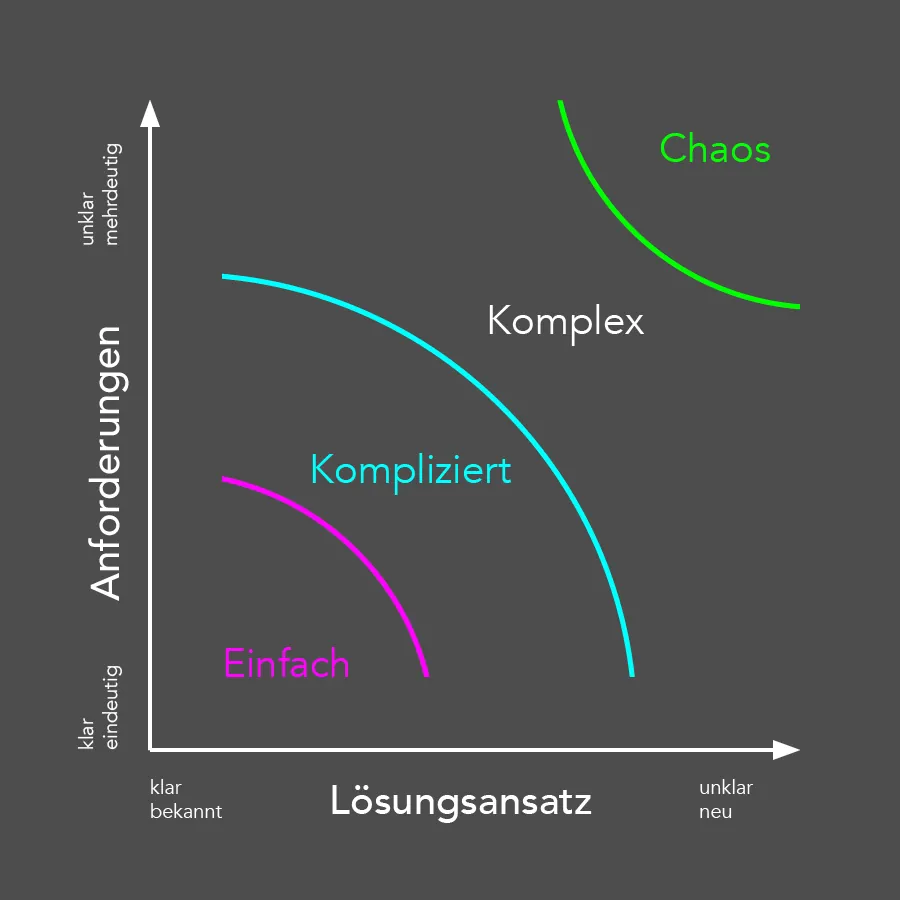
– Simple project
– Complicated project
– Complex project
– Chaotic project
Examples of using the Stacey Matrix
The Stacey Matrix follows the approach that agile methods are the most promising when the solution approach is unclear. Agile methods allow the greatest possible flexibility. They let you react faster to changes and new requirements. When you work in an agile way, you keep making assumptions and continue working on the basis of these assumptions. If the conditions change, you can change things and set a new course more quickly in an agile context.
However, if the project has low complexity, you should give traditional methods priority over agile methods. In this case, tools such as best practices, past experience and checklists help you reach your goal. The work is easy to define and distribute, and everyone quickly knows what they have to do.
infra-struktur adapts to you
With infra-struktur, you create a digital workplace tailored to you and your most important topics. And your project management is part of it too.
Criticism of the matrix developed by Stacey
The Stacey Matrix is a simple tool, as it only shows two dimensions. That is also the main criticism of it. These two dimensions are not always enough to represent the complexity of a project.
Advantages of the Stacey Matrix
The matrix developed by Stacey has two decisive advantages that you can use for project management. For one, the matrix is a very flexible tool. It can be used not only in project management but also outside it. By showing the degree of complexity, it makes decision-making easier. The Stacey Matrix then helps you identify suitable methods to carry out the project successfully.
Starting a new project in particular is often difficult. At the beginning, many things are unclear and the first steps can be hard. It helps to choose the right project management method – whether agile or traditional. With a suitable method, it is easier to make the project a success.
Conclusion: how the Stacey Matrix can help in everyday work
In demanding everyday work, the Stacey Matrix can be a good aid for assessing situations in terms of their complexity. The simple, two-dimensional matrix lets you map problems and challenges graphically. The result helps you decide, for example, whether you should approach a new project in an agile or a traditional way.