Recognising and dealing with untruths in the office
How do I recognise lies and what are the consequences for my working environment? How do I deal with it when I notice untruths in the office?
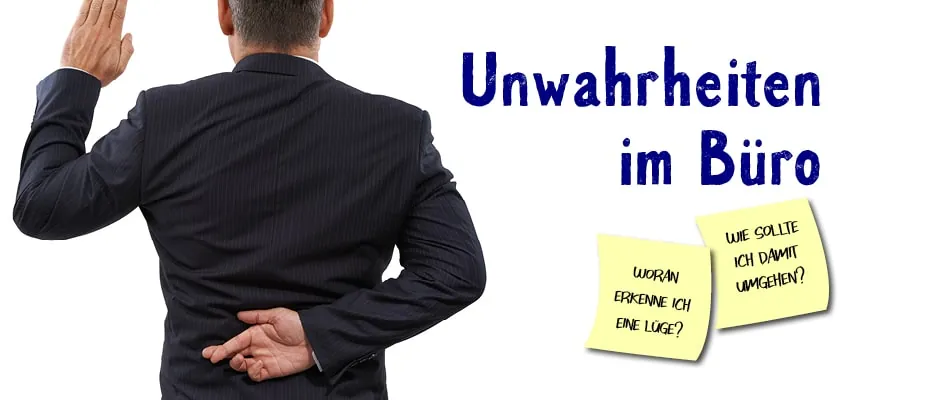
Untruths in the office are a widespread phenomenon that can have serious effects on the working atmosphere and productivity. Whether out of ignorance or with the intention of harming others: lies at work undermine trust within the team and impair cooperation.
Is there new information on prices? Has the customer got back to us yet? What is the status quo in the project, can the deadline be met? Precise information is essential to ensure a smooth workflow. When the clockwork of integrity gets stuck, it causes problems at various levels.
Untruths in the office: what are the consequences?
To put it quite clearly: spreading untruths in the office is no trivial matter. Of course, it always depends on the context of the untruth. Nevertheless, the short, medium and long-term consequences can be these:
Loss of trust
- Between colleagues: lies erode mutual trust and make effective cooperation more difficult.
- Between managers and employees: untruths damage the relationship and reduce respect and authority.
Negative effects on team dynamics
- Communication breakdowns: false information disrupts open exchange and encourages misunderstandings.
- Conflicts and tension: lies are often the breeding ground for conflicts that worsen the working climate.
Impaired work performance
- Loss of efficiency: untruths lead to wrong decisions and inefficient processes.
- Reduced quality: work results suffer from false information.
Psychological effects on employees
- Stress and uncertainty: the fear of being deceived increases stress and causes uncertainty.
- Demotivation and falling morale: an environment shaped by lies wears down motivation and satisfaction.
Long-term consequences for the company
- Loss of reputation: repeated untruths damage the company’s standing.
- Financial losses: inefficiency, high staff turnover and lost customers lead to financial losses.
Why are untruths spread in the office at all?
Untruths spread in the office for the following reasons, which are often rooted in human nature, the working environment and the corporate culture:
- Self-protection: employees avoid criticism or consequences by covering up mistakes.
- Striving for recognition: some people embellish facts to put their achievements on an (undeserved) pedestal and gain recognition or promotion.
- Competitive pressure: in highly competitive environments, envy and the need to prevail can lead to untruths.
- Group dynamics: the pressure to conform or to avoid conflicts can drive people to untruths.
- Corporate culture: a company in which mistakes are not tolerated should not be surprised by untruths.
- Communication problems: a lack of clear communication and insufficient responsibilities encourage misunderstandings and misinformation.
In short: untruths in the office are often a reaction to the fear of negative consequences, the desire for recognition and the influence of the working environment.
Your digital communication across the whole team
Both your internal and external communication are fully documented in your digital workplace. So everyone in the team knows the current state of things and saves themselves unnecessary questions.
Safe space: a modern culture of dealing with mistakes, properly lived
In a real safe space, employees can express their thoughts freely and admit mistakes without having to fear negative consequences. Transparent communication and dealing openly with mistakes help to avoid misunderstandings and lay the foundation for strong cooperation based on trust.
To create such a space, managers must lead by example. They should address mistakes constructively and openly and show that failures can be learned from. A modern culture of dealing with mistakes recognises that mistakes are unavoidable and offers the chance to learn and grow from them.
What measures are there against untruths in the office?
If you come across untruths in the office, act wisely and with care. Here are some steps you should consider in order to handle the situation:
- Clarify the facts: before you even think about raising the subject, make sure that untruths really are involved. What exactly was said? What really happened? If you have evidence such as an e-mail or a witness, you are on firmer ground for voicing your concerns. In any case, be extremely careful not to damage a colleague’s reputation unjustly.
- Have a personal conversation: the first step should be to speak directly to the person who spread the untruths. Choose a quiet place for a one-to-one conversation – away from other colleagues. This gives both sides the opportunity to communicate openly without the situation escalating. If the other person shows no understanding, you can mention that you may be forced to take the matter to a higher level if necessary.
- Reduce contact: depending on the reaction to the conversation, you can decide to minimise contact with the person. It is not always possible to avoid someone completely at work. But you can try to limit interaction to the bare minimum to protect yourself from further untruths.
Untruths, lies, gossip: a fine line
What must on no account be overlooked when it comes to untruths is that there are different levels on which they occur. In both personal and professional contexts, there is often a fine line between harmless white lies, strategic half-truths and destructive lies.
On a personal level, small untruths may serve to avoid conflicts, maintain harmony or forge alliances. The office where nobody gossips probably has yet to be invented. Personal sensitivities and emotions are simply part of being human.
But in a professional environment, where there is more at stake and the consequences are more far-reaching, spreading untruths can quickly lead to a loss of trust. Even worse: the integrity of the company can suffer as a result.
Conclusion
Effective measures against untruths in the office
There have always been untruths in the office, there still are, and there always will be. But each individual can work towards reducing them. Managers do this through a modern culture of dealing with mistakes, team members through appreciation and by focusing on the facts rather than on personal sensitivities. Because when everyone pulls together, untruths in the office don’t stand a chance.