Office of the future
What will the office of the future look like, and what does it mean for you as a business owner when the virtual office becomes more important?
The world of work is constantly changing. There are many reasons for developments in this area of life: on the one hand economic factors and influences such as globalisation, on the other technical innovations that help ensure that the world in which we work day after day is constantly changing. Of course, office work is not exempt from major changes either. The coronavirus crisis, which took its course in Europe in the first quarter of 2020, also shows that this area in particular has a great deal of catching up to do in order to better meet the requirements and needs of the near future.
For business owners, it is extremely important to engage with this new world. This applies in particular to office topics related to digitalisation. Only then is it possible to offer motivated employees an environment in which they enjoy working and can fully realise their potential – because your employees’ success is usually also your success. So what does the ideal workplace of the future look like? What points do you need to pay particular attention to in order to retain your employees in the long term?
The workplace of the future – it has to be flexible
Not only digitalisation but also flexibility is one of the important future topics when it comes to office work. The coronavirus crisis has shown that it can sometimes be extremely important to be able to adapt quickly to new situations. Only if certain conditions are created is it possible to keep the business running even in exceptional situations.
The aspect of flexibility relates both to the IT structure and to the office space itself. A flexible IT infrastructure should, for example, allow employees to switch quickly to working from home when needed. Among other things, the IT infrastructure must provide access to all kinds of work data and to the company intranet – in future, working from home should no longer have any disadvantage in this respect compared with a normal workplace in the company building. A flexible IT structure that can be used widely can of course also bring lots of advantages on a business trip. It saves time and enables employees to work efficiently on site.
Flexibility in terms of office premises should not be underestimated either. Here, too, the coronavirus crisis has shown companies very clearly that it may become necessary to react quickly to new conditions. We are talking about minimum distances, the installation of equipment for better hygiene and other concepts used during pandemics. But flexible offices can also be an advantage in normal times. Today, work is often project-specific. This means that teams have to be formed and disbanded more quickly. A flexible office concept can better support processes like this in the company, as adjustments to various requirements can be made more quickly.
Communication in the office of the future
Digital technologies are increasingly being used to communicate – both privately and in business. Until recently, everyday office work involved a relatively large amount of conventional phone calls to make enquiries, deal with problems or get other things done. For more complex problems or longer discussions with several people, there were meetings or customer visits, usually held in special meeting rooms. During the coronavirus crisis, much of this was no longer easily possible.
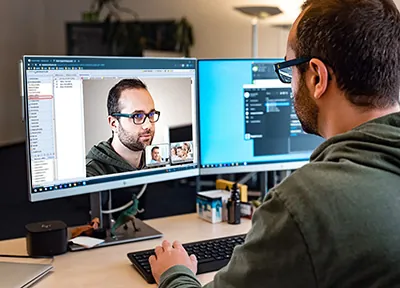
Video conferencing tools (opens in a new tab) and other digital communication technologies were used on a large scale so that meetings could still be held. Of course, tools like this existed before the crisis – but they were not used to this extent.
It is very likely that many companies have come to appreciate the benefits of these digital technologies and will continue to use them. As a result, major leaps in development can be expected in this area. So it will be exciting to see what the workplace of the future brings in this respect. Perhaps the quality and performance of video conferencing systems will soon be so high that virtual meetings will feel extremely close to reality.
THE VIRTUAL OFFICE IS GAINING IN IMPORTANCE
The office of the future will very probably increasingly take place in virtual space. At least some activities and processes will probably be handled mainly digitally. Online video conferencing technologies are just the beginning. Digital tools that make it possible to see the screens of employees or project team members allow communication and collaboration just as you are used to in a conventional environment.
Cloud solutions and intelligent digital document management can also help increase the efficiency of various processes. The main advantage of these technologies is that work is increasingly separated from location – resulting in maximum flexibility. Long journeys, and with them a lot of time, are cleverly avoided, as employees can usually stay at their desks to work on certain things. In addition, you can let your employees decide for themselves whether they would rather work in the office in the company building or at home. For many people, this kind of freedom of choice can turn out to be a real benefit.