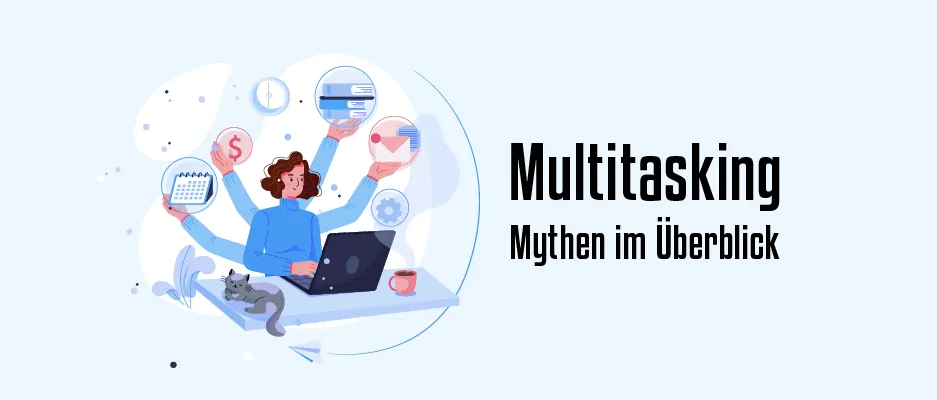
Multitasking: an overview of the most common myths
The biggest myths about multitasking and what really helps you when you have to work on lots of tasks in parallel at the same time.
Everyone is talking about multitasking. Checking your e-mails during a conference call and then carrying on working on the presentation. For many people, this is the reality of everyday working life. We believe that multitasking lets us work more efficiently and faster and get more things done in the same time. But even if we believe it and there are a number of myths surrounding it: there is no gain in efficiency.
On the contrary: we rob our brain of valuable resources. Our grey cells are designed to work on a single task at a time. There is no such thing as a brain that can handle several tasks well at the same time. This article therefore looks at the biggest myths and also explains what really helps you when you have to work on lots of tasks in parallel at the same time.
What is multitasking?
The term multitasking comes from information technology. There it refers to the process in which a system has to perform several tasks at the same time. A computer does this by switching between the different tasks at short intervals. This creates the impression that they are being performed simultaneously. With only one CPU core, there is no multitasking. With several CPU cores, it is easily possible. Up to a certain point, every system can run several processes at the same time. How many depends on the memory. But at some point, every system reaches its limits and a crash looms. Because there is no such thing as a system that always works.
Multitasking in the working world
Even though the term comes from IT, it has long since found a firm place in everyday life and in the working world. Multitasking is something we all know, and it seems to be positively “in”. But more and more people are experiencing first-hand that doing tasks in parallel does not really work well. The idea that some people are good at it belongs to the realm of myth. Just as a CPU core cannot perform two tasks at the same time, our brain can only concentrate on one task. There is no such thing as working simultaneously. Rather, the brain has to keep jumping back and forth between the tasks, and that takes an enormous amount of mental energy. So it is not a myth when scientists say that effective multitasking does not exist. For the brain, “monotasking” is ideal, that is, focusing on a single task with full concentration. And until this task is done, it is best not to start a new one. In the long run, this can lead you all the way to burnout.
Keep track of your tasks
So that you can concentrate on your working day, your infra-struktur only shows you the tasks that are currently relevant to you.
The myths about multitasking
A lot is said about multitasking. The most common myths are summarised in the following section.
Myth check: multitasking also has advantages
That is wrong, because there are no advantages. If you tackle several tasks at the same time, your body releases more stress hormones. In the long run, this is not good for the body and can make you physically and mentally ill. Unfortunately, many people have already got used to being permanently stressed and can no longer switch off at all.
Myth check: the human brain can perform several tasks at the same time
That is just as wrong, because the brain does not work in parallel. This is one of the biggest myths about multitasking. Our brain is designed so that it can only concentrate on one task. For example, it has been proven that people who make phone calls while driving are involved in accidents more often. This is because the brain can only concentrate on one thing: the traffic or the person on the phone. When we are in “multi-task mode”, our brain switches rapidly back and forth between the tasks. This happens at intervals of milliseconds and uses up an enormous amount of mental capacity. And as a result, everything takes much longer.
Myth check: multitasking makes you more productive
The idea sounds plausible somehow: if you devote yourself to several tasks at the same time, productivity rises. But the opposite is true. We do not become more productive when we tackle several things at once; instead, our own performance drops – whether we want to admit it or not.

Myth check: women are better at multitasking than men
There is no such thing as women who can multitask. This is one of the myths that is particularly persistent: women are supposedly better at multitasking. Science has not been able to prove this so far. Of course, there are individual differences, but they are not specific to gender. The myth probably comes from the fact that mothers in particular have to multitask in everyday life. The baby on one arm, the food on the stove and the phone to their ear. That is what everyday life looks like. Somehow mothers manage this balancing act. But they often feel burnt out and drained at the end of the day. Because there is no such thing as a brain that can multitask.
What helps against multitasking?
So that you are not tempted to keep jumping between tasks, start by making an overview. In it, you can categorise and prioritise tasks. If you work on tasks with similar topics one after the other, this takes the strain off your brain. It also helps to reserve fixed time slots in your calendar in which you can work with concentration. And finally, one very important tip: learn to say no! Because if you constantly feel that you have to do several tasks at the same time, you have too much on your plate.