Lone wolves and working in a team: background and tips
Find out how, as a manager, you can recognise lone wolves, put their strengths to targeted use in teamwork and so make the most of your team’s potential!
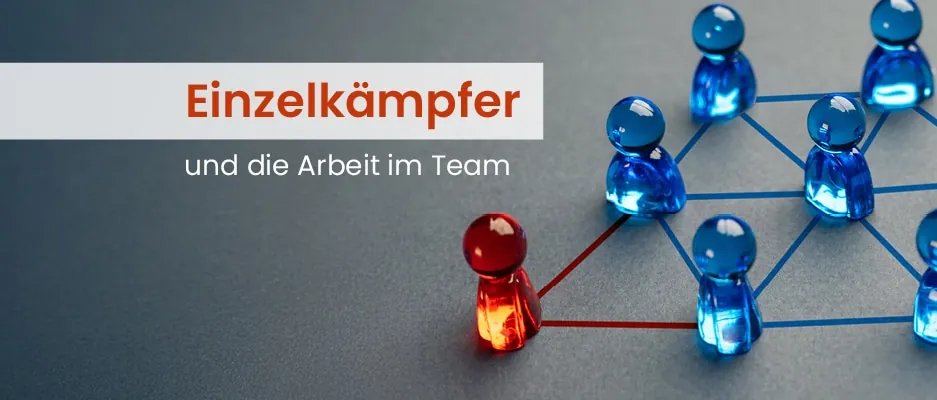
Lone wolves are hardly noticeable, yet they are found in almost every company. No other personality type is such a master at flying under the radar at work. They dread working together in a team, so they often seem out of place in jobs with collectively organised work processes. And yet these committed loners have unexpected potential. Here you can find out how to recognise lone wolves at work and how best to deal with them.
These statements are typical of lone wolves
Are loners unable to work with others, or do they just not want to? There is no simple answer to this question, because the reasons for their tendency towards individualism are many. It is less difficult to identify lone wolves at work. Their attitude shows in the following statements.
“I’d rather do that myself!”
Lone wolves shy away from teamwork and like to do their tasks alone. Some of them put up with exchanges with colleagues as a necessary evil, others refuse completely. Both types have one thing in common: if it were up to them, they would carry out their tasks and projects entirely on their own.
“Teamwork is too much effort for me!”
Most individualists find working in a group a nuisance. What is interesting is how varied the reasons for this attitude are. Some of them naturally prefer to keep to themselves and simply see no point in exchanging ideas with others – whether in their private or professional lives. For others, on the other hand, the rejection is a protective mechanism based on a lack of self-confidence.
“My colleagues’ feedback is no use to me!”
Working in a team is not just about implementing a particular project together. Many interpersonal processes also take place that put the soft skills of those involved to the test. This includes accepting feedback from colleagues. Lone wolves believe they do not need this response. Whether this is due to an inability to take criticism or to strong self-confidence differs from person to person.
“Help from others!? I don’t need it!”
Nothing is further from a loner’s mind at work than asking colleagues for help. In this context, many of them develop into excellent problem solvers. But this behaviour can also have a negative effect on the group and the company as a whole. This is the case, for example, when the person’s know-how is not enough to find a solution. Simple work steps then take a lot of time, although they could be done quickly after a short exchange with other team members.

The strengths of going it alone at work
Employers often underestimate the valuable skills that lone wolves bring. They largely organise their working day themselves and rarely interact with colleagues or managers. Their ability to work independently is correspondingly strong. Because they only fit into the team to a small degree, they are exposed to fewer distractions. They keep their goal firmly in sight and are able to pursue it consistently. So lone wolves are often marked by a strong ability to concentrate and a high level of commitment.
Despite all these positive aspects, committed lone wolves can be a challenge for colleagues and managers at work. Unlike self-confessed team players, dealing with them properly calls for a little more sensitivity. But in most cases the effort is worth it. Given a little support, individualists make a valuable contribution to the company’s success. The following section shows you the strategy you can use to encourage them.
3 steps to dealing better with lone wolves at work
It is not true that loners are a hopeless case when it comes to teamwork. Often small measures are enough to awaken their willingness to cooperate, at least in part. With the following three steps, you can involve individualists more closely in the group – without any pressure.
1. Identify the reason for the loner behaviour
Try to find out together with the person why they avoid working in a team. There may be a specific cause that you can easily fix. Perhaps the employee simply can’t see eye to eye with colleague A, but is quite willing to work with colleague B.
Of course, lone wolves in companies should learn to get along with all team members. But if a small change to the group line-up is possible and does not have a negative effect on the other employees, it is worth a try.
2. Put the focus on the advantages of teamwork
Admittedly, working in a team can be tedious and nerve-racking. But it can be different. The loner may have had only negative experiences with other colleagues in their working life so far. In that case, it helps to stress the benefits of working together.
Highlight the aspects of working together that even individualists benefit from. These include, for example, a lighter workload, because the work is shared among several people. That way you make it clear that cooperation benefits every single team member and not just the company.
3. Make use of the loner’s strengths
People who like to keep to themselves at work are usually quiet and hardly noticed. As a result, they miss out on appreciation from managers and colleagues, and withdraw even further. You can counteract this negative development.
Keep in mind the loner’s strengths mentioned above. You will quickly see that their ability to work independently and with focus can serve as a role model for other employees. Team players and loners can therefore learn from each other – and you should make this clear to both sides.