The iceberg model for successful communication
Learn how to use the iceberg model and Freud’s insights into communication to understand the invisible levels and make your conversations at work more successful!

The well-known philosopher and communication scientist Paul Watzlawick coined the following axiom: “One cannot not communicate.” And if you deal with people at work every day, you surely know how important communication is. After all, missing, faulty or incomplete communication tends to lead to problems. One way of gaining a better understanding of communication at work is the iceberg model. It takes into account not only what you or your employees say but also the context of what is said.
Background and origins of the iceberg model
The iceberg model is one of the key components of communication theory. It originally goes back to the general theory of personality of the famous psychoanalyst Sigmund Freud. However, he never used the term “iceberg model”. It was only coined later by Paul Watzlawick.
Sigmund Freud’s theory of personality on human consciousness
Freud’s theory of personality divides the human mind into three levels:
- Conscious: perceptions and feelings
- Preconscious: information that can be recalled at any time
- Unconscious: factors that act without our knowledge
The theory also has three levels of personality: the ego, the superego and the id. The ego is also known as the reality principle. This level is about conscious and visible things, i.e. what we generally understand as communication. The superego is also known as the morality principle. This level is about largely unconscious things from the area of norms and values. The id embodies the pleasure principle. It reflects human drives and needs, which often lie in the unconscious.
The iceberg model and its two levels: content and relationship
The iceberg model consists of two levels: the content level and the relationship level. The two levels are connected and cannot be considered in isolation. They bring together the conscious and the unconscious.
The content level is the visible and conscious part of the iceberg, or of communication. This level includes facts and figures, but also wishes, if they are expressed, and considerations. The content level is by far the smaller part of the iceberg and is seen as its tip.
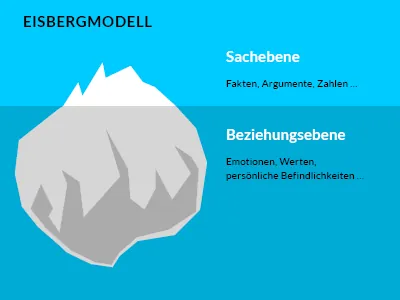
The much larger part of the iceberg, which cannot be seen from the outside, is the relationship level. This level includes the preconscious and the history, along with the body language of the person communicating.
All these factors are added to the communication on the content level and play a major part in how a message is received. For the most part, it is not about facts but about moods, feelings, values and motivations.
If the relationship level is neutral, communication is usually neutral too. However, it becomes more difficult when the relationship level is already negatively charged. This then influences the content level. After all, the model illustrates that only about 20% of communication takes place consciously (i.e. on the content level). The majority, more than 80%, takes place non-verbally, i.e. below the surface. And that is exactly what often makes communication so difficult, because it is about things left unsaid.
Good communication needs context
What has already been discussed? What has been agreed? And what happened most recently?
With infra-struktur, your team has important customer information and previous communication in view in one central place – so conversations do not start from scratch.
The iceberg model in practice
Now that you know the background to the iceberg model, it is easier for you to improve your communication in your everyday work. You will no longer just pay attention to what you say or what others say, but also to how they say it and in what context. By applying the iceberg model and the following tips, you will be able to improve your communication at work considerably.
Use your body language deliberately to support the conversation
When you talk to an employee, turn towards them actively and pay attention to whether you have a connection (rapport) with each other. If this connection exists, communication on the content level will run much better and be more focused. It is also advisable to be physically on the same level during the conversation. If you want to talk to a colleague who is sitting down, sit down too. If someone is standing, stand up as well. That way you can communicate with the other person at eye level in the truest sense of the word.
Listen actively to the other person
Listen actively to your employees. This means not only giving the conversation your full attention, switching off your mobile phone and closing your office door, but also taking an active part in the conversation. This includes asking questions or summing up and repeating what has been said in your own words.
Pay attention to your colleagues’ communication preferences
Everyone has different preferences when it comes to communication channels. There is, for example, the colleague who prefers to pick up the phone straight away and likes to discuss everything by phone. Another prefers to write e-mails, a third colleague prefers a face-to-face conversation to all other options. And a fourth prefers to use Teams to communicate, even if you are sitting just three metres away. If you know your colleagues’ preferences, you can adapt and reach them on the right channel.
The same applies to the style of language. Some employees prefer direct requests and instructions. Others feel attacked by a direct style and prefer to have things put tactfully. Especially if you work in an international environment, knowing about linguistic subtleties can be a real game changer.
Many channels of communication – but one shared information base
Phone, e-mail or face-to-face agreement: today, information comes about in many different ways. infra-struktur helps you bring relevant customer information and processes together in one central place.
That way, your team does not first have to find out where something was discussed but can carry on working straight away with the necessary context.
Conclusion on communication in everyday working life
In everyday communication – whether at work or in private – it matters not only what you say but also how you say it. Always bear in mind that the ratio of verbal to non-verbal communication is about 20 to 80. In conversations, pay attention to the subtle signals in body language, tone of voice, facial expressions and gestures.