Johari window – self-perception and perception by others
Simply explained, the Johari window is a model for comparing self-perception with how others perceive you.

Where does the term Johari come from?
The name Johari is made up of the names of the two social psychologists Joseph Luft and Harry Ingham. As early as 1955, they described how perception by others and self-perception affect our own behaviour. They recognised that every person’s blind spot influences group dynamics. That is why they developed the Johari window. It makes our own perception clear. It can be used to improve cooperation between group members.
What is the Johari window?
The whole window consists of four fields. At the top, known to self and not known to self are entered side by side. On the left-hand side next to the Johari window, the descriptions known to others and not known to others are written. This gives the four parts of the window their weighting.
The four fields of the Johari window
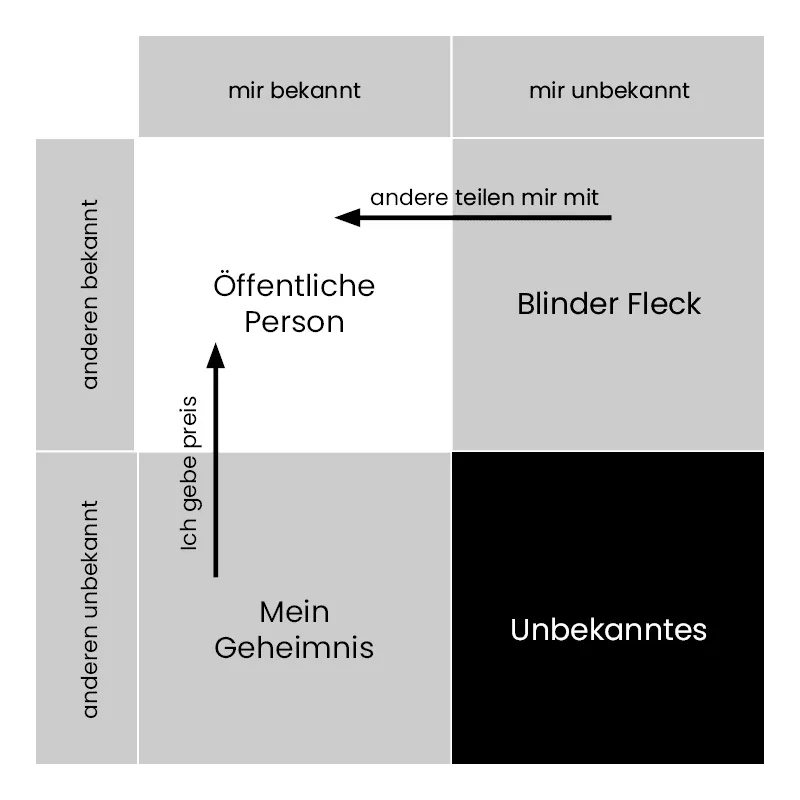
The “public person” has its place in the top left part of the window. To the right of it is the “blind spot”. The areas below are labelled “my secret” and “unknown”. The public person describes all the aspects that are obvious to the person themselves and to all the other members. Name, age and employment are usually known among colleagues. Marital status and other personal details may not be a secret either. To the right of it is your own blind spot. This lists the aspects that the person does not recognise themselves. The other group members perceive them clearly. They can be quirks and habits. Frequent blinking is noticed by other people.
The person interrupts others in conversation without being aware of it, but this may annoy the other members. In the second row, personal secrets and unknown things sit side by side. The first area can be filled with content that is classed as private. Some of it concerns the person’s own life story. It can be events from the past or wishes that are kept from the other members. The list of unknown things is unfamiliar to both sides. It can be content from the person’s own past that has been forgotten. The largest part of one’s own personality lies dormant in the dark.
Goals and tools of the Johari window: feedback and self-disclosure
Luft and Ingham developed the Johari window to improve communication in the group. At the same time, Johari is a tool that can be used to train self-perception. Comparing it with how others perceive you uncovers blind spots.
Procedure: during a group training session, the members are given the Johari list of 56 specially selected adjectives. All participants may choose between 5 and 6 words that describe the subject well. Working together, the members then place the attributes in the corresponding part of the Johari window. Through the comparison, the person concerned will recognise how their self-perception differs from the way others perceive them. Working with the group makes it clear that perception is influenced by all four areas.
Secrets block communication. When secrets are revealed, a special energy can be released. The strength that was previously needed to hide secrets is now available for other areas. The way others perceive you changes immediately. Greater openness can expand your own potential.
Tips on how to apply the Johari window
Training your perception means that self-perception and perception by others improve equally. This can have a particularly positive effect on the whole team, because blind spots can be used openly. A problem that is named openly changes how listeners perceive you.
A person who does not like speaking in front of many people often tries to hide it. This leads to insecurity and nervousness. The listeners’ perception is influenced by the mistakes that occur. If this person begins the talk with a disclosure, it changes the group. “You all know that I do not often speak in front of many people. I would still like to present this information to you.” With an introduction like this, the listeners understand that the speaker feels unsure. Hesitating or stumbling over words is not seen as carelessness, and after the talk the person is gladly encouraged to take up such opportunities more often.

Advantages of the Johari window
The feedback from the group members improves self-perception. The blind spot shrinks visibly. Unconscious behaviours enter your own perception and expand your awareness. Quirks that are experienced as weaknesses can now be actively worked on. An openness to working together in the group emerges, which can be used positively. Unwanted behaviours can be tackled openly and, at best, even eliminated. Perceiving yourself also changes the way you come across. Growing openness means that the other person opens up more easily too. Honest dealings with each other intensify all communication. A team or group that has worked with the Johari window improves its perception for good.
Conclusion
The inventors of the Johari window recognised that self-perception and perception by others are directly connected. Perception influences what a person hears and what of it they remember. If a group or a couple wants to work together effectively, the blind spot should become steadily smaller. Secrets that arise from fear or shame disrupt communication. These disruptions lead to results of lower quality. Working together feels more pleasant when there is greater openness. A subjective weakness then becomes a strength that can be used positively.