Cloud server hosting & cloud computing
Cloud server hosting & cloud computing are not trends, they are the digital future. But what are the benefits?
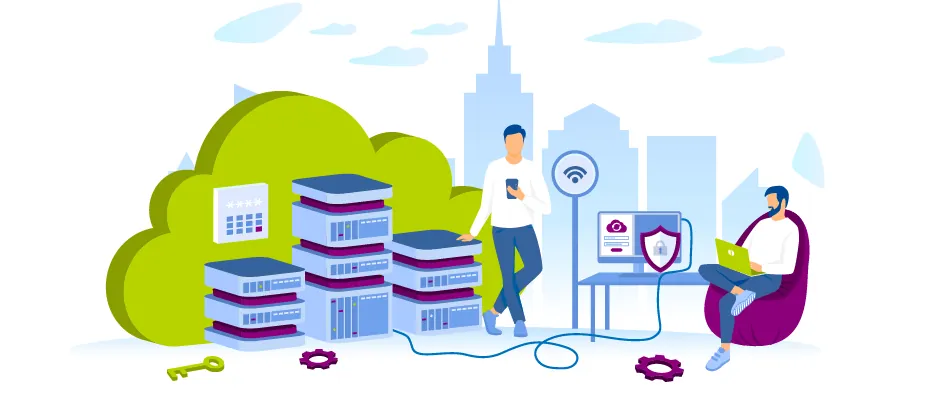
More and more companies of all sizes, regions and industries are turning to cloud computing. But what exactly is a cloud server, what is hosting and what are the benefits? Before we look at these, let us first shed light on what exactly this server solution is.
Computing in the “cloud”
Put simply, this kind of computing is data processing based on the internet. In the past, users ran applications or programs that were installed on a physical computer or server in their building. Cloud computing makes it possible to access the same kinds of applications over the internet. The data produced in the process is stored and processed by remote servers (also called cloud servers). This means that the device accessing the cloud server is not under such heavy load. By hosting software, platforms and databases, the cloud servers free up the storage space and computing power of individual computers. Users can securely access cloud services with login credentials they receive from the cloud computing provider.
Benefits of cloud computing
The most important benefits for companies that rely on a cloud infrastructure
High speed – fast deployment
A new cloud computing server can be deployed in no time at all and adapted to current business requirements. In short, you are agile, flexible and of course independent of location. In addition, the IT department, whether in-house or external, can provide much better support without setting a single foot in a server room.
Efficiency and cost reduction
By using a cloud server infrastructure, you do not have to spend vast sums on buying and maintaining equipment. This drastically reduces investment costs and the total cost of ownership. You do not have to invest in hardware, utilities or building a large data centre to grow your business. You do not even need large IT teams to run your cloud data centre, because you draw on the expertise of your cloud provider’s staff.
The cloud also reduces the costs associated with downtime. Since downtime is rare in cloud server systems, this means you do not spend time and money fixing potential problems related to downtime.
Data security
One of the main concerns of every company, regardless of size and industry, is the security of its data. Data breaches and other cybercrime can harm a company’s revenue, customer loyalty and brand positioning. Cloud servers offer many advanced security features that guarantee data is stored and processed securely. Cloud hosting providers (opens in a new tab) implement basic protective measures for their platforms and the data they process, such as authentication, access control and encryption. From there, most companies add their own security measures to these protections in order to strengthen data protection in the cloud and tighten access to sensitive information on the server.
Scalability
Different companies have different IT requirements – a large company with over 1,000 employees does not have the same IT requirements as a young company with a team of 10. Using cloud hosting is a great option because it allows companies to adapt their IT departments efficiently and quickly to business requirements. When your business requirements grow, you can easily increase your cloud capacity without investing in physical infrastructure. This level of agility can give companies that use cloud computing a real advantage over competitors. This scalability minimises the risks associated with internal operational problems and maintenance. You have powerful resources with professional solutions at your disposal, without any upfront investment. Scalability is probably the biggest advantage of hosting in the “cloud”.
Collaboration
Cloud environments enable better collaboration across teams: administration, quality assurance, operations, sales and product architects are all assigned to the same infrastructure and can work at the same time without stepping on each other’s toes. Different cloud environments can be created for specific purposes. It is much easier to work together transparently.
Unlimited storage capacity
In line with the scalability advantage mentioned above, hosting on a server essentially offers unlimited capacity for storing any kind of data in different types of cloud data storage.
Backing up and restoring data
The fact that data can be stored in the cloud without capacity bottlenecks also helps with backup and recovery processes. Since end users’ data changes over time and has to be tracked for legal or compliance reasons, older software versions can be stored for later phases in case they are needed for a recovery or a rollback.
Disaster recovery
Storing earlier software versions in the cloud and running production instances in several cloud availability zones or regions enable faster recovery after data crashes: if your application is deployed at several locations and one region fails for any reason, traffic can automatically switch to the working regions without interruption for end users. In other cases, where there is a serious error in the software version, a quick rollback can be started to restore a previously released, more stable version and minimise the damage.
Conclusion
The adoption of cloud computing is increasing every year, and it does not take long to understand why. Companies recognise the benefits of cloud computing and see how it affects their production, collaboration, security and revenue. By using a cloud-based solution, a company can avoid many of the problems that plague companies relying on local infrastructure.