Data protection in the workplace
In the workplace, data protection should be treated with particular care. We use examples to show which measures need to be taken.
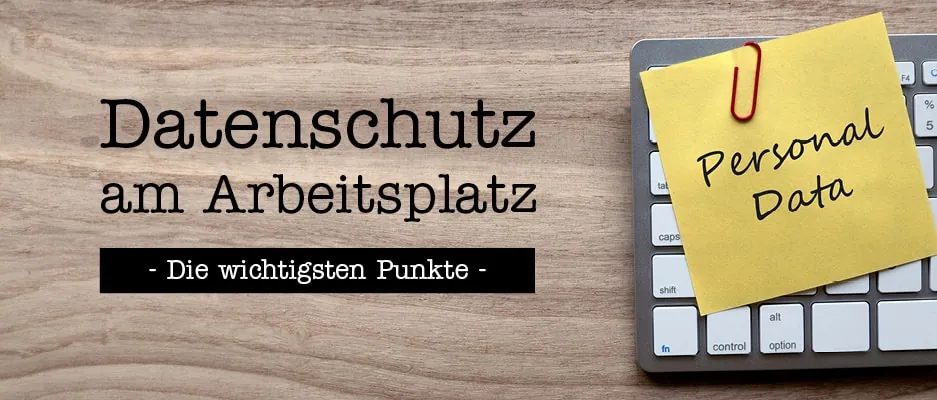
No company can do without data today – whether it is employees’ personal data needed to conclude their employment contract, customer data in the CRM system or data that has to be accessed for business processes. Since the General Data Protection Regulation (GDPR) came into force in 2018 at the latest, data protection has become an integral part of everyday business and is probably on your agenda again and again too. This article describes the most important measures that business owners must take to protect data in the workplace.
GDPR: the legal basis for data protection
Since 25 May 2018, the European General Data Protection Regulation (GDPR) has applied directly in all EU member states, including Germany. The European Union’s aim with the regulation was to create uniform rules for companies on how personal data may be collected, gathered and processed.
Examples of personal data protection in companies
Personal data is data that relates to a clearly identifiable person and can be used to determine who that person is. Here are some examples of personal data in a business context:
- Name
- Address
- Identity card number
- Date and place of birth
- Location data, for example from a mobile phone
When employers may process personal data
Companies may process personal data in two cases:
- There is a legal basis for processing the data (without the employees’ consent).
- The employees have given their consent, for example by personal agreement or through a works agreement. This consent is voluntary and must be given in writing.
The role of companies in protecting personal data
Companies have to collect, process and store personal data. This already starts in the application process and continues with the employment contract. It is important to obtain the consent of the people whose data is collected, or to show on objective grounds that working with the data is necessary. For an employment contract, for example, personal data such as name, address, date of birth and bank details have to be collected and stored. Otherwise, registration with the health insurance fund and payroll are not possible.
Note, however, that data may only be collected for a specific purpose – and always in line with the principle of data economy. This means: the less data, the better.
The principle of data economy
The GDPR speaks of the principle of data economy or data minimisation. This means that as little personal data as necessary should be collected and stored. If, for example, an online shop requires the phone number as a mandatory entry in addition to the e-mail address when an order is placed, this could be a breach of the principle of data economy. After all, the e-mail address is usually enough as a means of contact for processing an order.
What employees must bear in mind when processing data
If you run a company, you are not obliged to train your employees on the GDPR and on handling data. However, there is an indirect obligation. After all, as a business owner you can be held responsible if data is misused or there is a data breach. If it then turns out that you have not informed your employees about how to handle data, this can have serious consequences. That is why it has become common practice in companies to offer regular training for employees to raise their awareness of how to handle data.
If an employee breaches the requirements of data protection law unintentionally and without intent, the employer is liable. Things are different with intentional or grossly negligent breaches by employees. In that case, the employee concerned can be held personally liable.
Assigning data access in a targeted way
In infra-struktur you can determine which employee gets access to which data. That way, each employee gets exactly the view of the data that is relevant to their area.
The employer’s duty to inform about data processing
The employer is obliged to inform employees about which of their data it processes, to what extent and for what purpose. Sometimes this notice is already part of the employment contract. Sometimes there is a separate letter informing the employees about it. This letter must point out that the employees can withdraw their consent at any time.
Which data companies may pass on to third parties
Sometimes companies need not only to store and process personal data but also to pass it on to third parties. This is the case, for example, when payroll accounting is handled by an external office or when the annual financial statements are prepared by an external tax adviser. In this case, a data processing agreement between the two partners is required. It must also be ensured that the data is transferred securely in accordance with the requirements of the GDPR.
Not only when transferring data to third parties but also when processing data within the company, firms should put suitable security measures in place. It is important to regulate access rights precisely to prevent unauthorised access, and to use special security software.
Appointing a data protection officer
Companies in which more than 20 people are regularly involved in data processing must appoint a data protection officer. This person’s task is to ensure that the company acts in compliance with data protection law and to monitor the measures. The data protection officer is also the contact person for employees, management and authorities. A data protection officer does not have to be an employee. The position can also be outsourced to an external service provider, which then takes care of compliance with data protection.
The employer’s duties to inform employees
Employers have duties to inform their employees about the collection, storage and processing of personal data. For example, they must say for what purpose the data is collected and who has access to it. They must also communicate whether the data is passed on to third parties and how long it is stored. The contact details of the data protection officer must also be disclosed.